Tag: Nature

  • Underwater gardens

    Underwater gardens

    Underwater gardens

    Advocates are taking seaforestation efforts into their own hands

    Nurturing seafood to grow

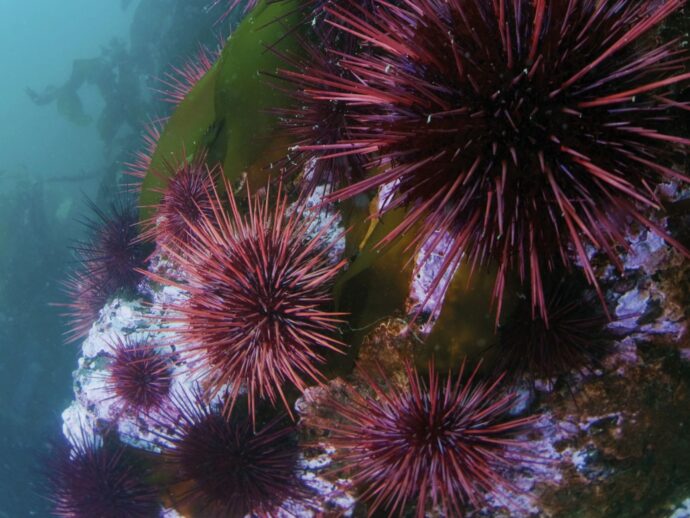
    The objective of “Chiix̱uu Tll iinasdll: Nurturing Seafood to Grow” project, an initiative aimed at restoring an area of kelp forest in Gwaii Haanas between 2017 and 2021, was collecting urchins to help rectify the area’s unbalanced food chain. Sea otters were important consumers of urchins before their local extinction during the maritime fur trade of the 18th and 19th centuries.

    Without predation, urchins have become hyperabundant, leading to the overgrazing of kelp, an important cultural resource to the Haida Nation, as well as an integral component of the world’s biodiversity and environment.

    Kelp lives near shorelines around the world and helps to nourish and house important underwater life. Much like forests on land, kelp’s photosynthesis process absorbs carbon dioxide, nitrogen, and phosphorous and releases oxygen—an important system in slowing the rate of climate change.

    But the Haida Nation isn’t the only area grappling with kelp loss. More than half of kelp forests worldwide have declined in the past 50 years, jeopardizing coastal biodiversity, water quality, and atmospheric carbon levels.

    An overlooked issue

    Underwater gardens are disappearing at alarming rates due to factors like habitat destruction, overharvesting and overgrazing, and pollution. Other challenges include climate change and sedimentation caused by runoff from deforestation, dredging, or storms. And, while ocean conservation has been around for decades, kelp preservation and restoration are relatively new.

    A 2021 paper published in the Frontiers in Marine Science journal measured the invisibility of kelp forests in international environmental governance. Researchers found that for every mention of kelp forests, seagrass meadows were mentioned seven times, salt marshes 20 times, coral reefs 38 times, and mangroves 43 times.

    A global call to action

    In 2023, The Kelp Forest Alliance launched the Kelp Forest Challenge, a global movement calling on everyone—from individuals to corporations and governments—to join the challenge of restoring 1 million hectares and protecting 3 million hectares of kelp forest habitat by 2040.

    Measures to restore and preserve kelp forests begin with the identification of their causes for decline. Controlling urchin populations or cleaning polluted water and sedimentation can help conserve threatened kelp, while seeding or transplanting baby kelp can aid in the growth of new forests.

    While countries like Japan and Korea have a long history of restoration efforts, and regions like California and Washington state are building conservation and restoration frameworks, to date, the Kelp Forest Challenge is the only conservation initiative that exists at an international level.

    An interconnected system

    In Haida Gwaii, the Haida Nation’s ethics and values serve as their guiding principles. Gina ‘waadluxan gud ad kwaagid, which means interconnectedness—an understanding that everything depends on everything else—serves as an important reminder about the biosphere’s fragility and vulnerability.

    by Alexa Everett

    Article Courtesy of Alive Magazine

  • Calling Dr. Tree, MD

    Calling Dr. Tree, MD

    Calling Dr. Tree, MD

    In 2023, health workers and volunteers planted more than 1,000 trees at Edmonton’s Grey Nuns Community Hospital. It’s all part of a nationwide movement to tap into one of the most well-documented forms of healing medicine: nature, green spaces, and forests.

    Trees are medicine

    Trees for Life, a national organization focused on creating a “healthier, happier Canada by planting native tress where we live, work, and play,” worked with the city in 2023 to plant nearly 20,000 trees across Edmonton, including the ones at Grey Nuns Hospital. Today, the hospital’s staff, patients, and the broader community have access to an enhanced public greenspace.

    It was the charity’s biggest tree-planting project in its history, but it wasn’t just about beautifying an urban space—it’s also the irrefutable evidence of how forests and nature improve every aspect of our general wellness and health.

    Take mental health, for instance. Researchers at Stanford University found that simply being exposed to nature decreased overall risks of mental illness.

    But that’s not all:

    • People with an office view of trees take fewer sick days and see a significant rise in productivity compared to those who don’t.
    • A systematic review of more than 50 different studies found that access to nature significantly reduced the odds of mortality from heart attacks and other cardiovascular diseases.
    • Hospital patients with a view of trees recover faster than patients who don’t have an outdoor view or who have a view but without trees.

    Experts say there may be many reasons for this since trees contribute numerous benefits, including increasing an area’s oxygen levels, muffling sound pollution, and creating cleaner air. While the underlying factors are multifaceted, the results are clear.

    And you can see that taking shape from coast to coast to coast.

    The growing movement to plant trees for health

    In 2023 alone, Trees for Life worked with 19 partners and 2,400 volunteers to plant 137,000 trees in Alberta, Ontario, and New Brunswick.

    Other organizations and projects include the Canadian Health Care Forests by the Canadian Coalition for Green Health Care; Trees for Hamilton, which recently worked with St. Joseph’s Urgent Care; and the City of London’s Million Tree Challenge, which has partnered with health care facilities like London Health Sciences Centre.

    From fewer hospital visits to lower reported stress and anxiety levels, these tree projects align perfectly with these hospitals’ goals. It’s a movement that continues to gain momentum to this day.

    by Joshua Duvauchelle

    Article Courtesy of Alive Magazine

  • Connect with nature this March

    Connect with nature this March

    Connect with nature this March

    Embrace the season and find joy

    Ask anyone what their least favorite month is and chances are March will be high on the list. Depending on what the weather throws at us, it can be more bleak than blossom, our doors still shut though we’re itching to bust them wide open. If winter feels like an annual rite of passage, then March is the final leg of it.

    Connect with nature

    How, then, do we make peace with this month? Regular connection with the natural world is one powerful strategy.

    Registered psychologist Sam Kriviak advises looking to nature as a model for being gentle with ourselves and the seasonal changes we experience in mood, energy, and productivity. “All species ebb and flow with the seasons in northern climates. The more connected we can be to nature, I think, the more we notice that our March will likely look and feel very different from our July or our October … and that’s okay!”

    Participants in a large UK study committed to some form of nature-based activity every day for a month. The result was an increase in nature connectedness, health, happiness, and conservation behaviors that lasted well past the 30 days. Spending time in nature can help foster physical health, and may even help to support our immune systems!

    Here are a few ways to foster connection in nature this season.

    Be attentive

    Simply locating ourselves in relation to Earth’s cycles can help us appreciate this time of year in a new light. Longstanding practices in your region, such as tapping of sugar maples or migratory bird counts, offer clues to the seasonal shifts happening around you.

    Do your own ancestral traditions offer a way to recognize this transitional month? And don’t forget to mark the spring equinox, either contemplatively or through a shared celebration such as a potluck, campfire, or walk with friends.

    Engage in comfort

    Direct contact with nature can be had even from a comfortable place indoors. Whether you’re eating, napping, or getting a little work done, position yourself where sunbeams are entering your home and soak them up.

    Get out there

    Nothing can perk us up quite like getting outside and imbibing the medicine of the natural world through our senses. Perhaps stroll at your kids’ pace, using an app to identify birds by their song or guessing which tree or plant you’re looking at based solely on its bark or dried seed heads.

    Use your head

    Even when the weather truly relegates us to the indoors, nature can work its magic through our imaginations. Children might enjoy drawing what all the underground life is up to this time of year: roots, worms, and microbes still slumbering or beginning to stir and wake.

    Get a jump on spring

    It’s the ideal time to begin many plants indoors, giving them a head start on the growing season. Planting seeds is an inherently optimistic act.

    By Jackie Skrypnek

    Article Courtesy of Alive Magazine

  • Got 15 minutes?

    Got 15 minutes?

    Got 15 minutes?

    Get active this fall!

    MAs the days shorten and the weather cools, physical activity often falls by the wayside, and we retreat indoors to curl up with a book or binge-watch a few shows. But the end of summer doesn’t have to mean the end of your fitness routine. Here’s how to keep moving.

    “We come off this high at the end of summer thinking, ‘I’m always going to feel this good!’” says wellness expert Sonia Jhas. “And then we hit this slump that starts, quite insidiously, in the fall.” By accepting that fall may shift how we feel, she says, we can plan ways to stay active and motivated—before colder weather hits.

    Embrace mini-workouts

    While you can get exercise by hitting the gym for an hour or going for a long run, smaller amounts of physical activity count too.

    Research shows that multiple five- to 15-minute bouts of movement throughout the day offer similar fitness benefits to a single longer session. With vigorous activity, health benefits start to accumulate at just 15 to 20 minutes per week.

    But activity doesn’t have to be vigorous. Mini-workouts of any intensity “can build to more of a routine and a better foundation,” says Jhas.

    Use what you have

    One of the great things about physical activity is it doesn’t require much equipment. Jhas recommends starting with just a few tools, such as free weights and a floor mat. Then, she says, it’s about doing movements that help build strength and boost your metabolism.

    For strength, try bodyweight exercises such as push-ups, squats, and pull-ups. Add in some burpees, jumping jacks, or mountain climbers for more cardio.

    You can also challenge yourself with everyday objects: cans of soup or a jug of laundry detergent for weights, a towel as a resistance band, or stairs for incline push-ups.

    Keep in mind that all movement counts, so if you want, clean your garden, play in the backyard, rake leaves, or learn line dancing.

    Get outside in nature

    While a home gym can keep you moving, Jhas also encourages people to get outdoors. “It may not be the same [amount of] exercise you were getting during the summer, but you can still maintain a positive relationship with being outside.”

    Focus on daily movements

    Here is some inspiration for moving throughout the week.

    Weekdays

    • Warm up, work out, and stretch.
    • Briskly walk to/from work or school and during lunch.
    • Break up periods of sitting with walking, yoga, and squats.
    • Walk during phone calls.
    • Do gentle stretches while reading or watching a show.

    Weekends

    • Get outside with family or friends for a hike, bike ride, or quick game.
    • Park farther away when shopping.
    • Pick your own apples or pumpkins.
    • Try a walking tour, dance party, bowling, or laser tag.
    • Briskly walk with family or friends before dinner.
    • Wind down in the evening with gentle stretches.

    By Shawn Radcliffe

    Article Courtesy of Alive Magazine

  • How to reconnect with nature

    How to reconnect with nature

    How to reconnect with nature

    Discover the joy of the season

    Seasonal living offers a way to rekindle our relationships with nature. In the process, we can uncover the joy and beauty in the natural world hidden in plain sight all around us.

    What is seasonal living?

    Humans used to live in a way that was innately more in touch with the seasons; indeed, many people around the world still do. Living in a way that is consciously connected to the seasons can be an intentional lifestyle choice through mindful daily practices.

    Benefits of seasonal living may include

    • improved mood and reduced stress due to spending time in nature
    • increased feelings of interconnectedness with the natural world and our place in it
    • the chance to slow down, reflect, and live in a more mindful, intentional way

    Seasonal living, every day

    There are myriad ways to live seasonally, and as always, it’s important to do what works for you. Here are a few ideas to help inspire you.

    Your kitchen

    Choosing local and seasonal food is one way in which we can eat in a more eco-friendly way, support our communities, and foster relationships with local farmers and food businesses.

    Simply start incorporating more locally grown in-season foods when possible, whether it’s from your own little garden or a store. Ask questions and chat with vendors at your local farmers’ market or the produce experts at your local health food store to learn more about the foods and how to cook them, as well as how they’re grown or produced.

    You can also incorporate mindfulness and gratitude practices into your mealtimes. Sunshine, water, and soil nourish the plants that, in turn, nourish us. Before eating, reflect on your food, its journey to your dinner plate, and the resources involved.

    Your decor

    Bring the outdoors in by incorporating some of the following suggestions.

    • houseplants
    • local, seasonal flowers
    • natural materials, such as acorns, chestnuts, pinecones, feathers, or driftwood
    • opening the windows for fresh air
    • making a seasonal garland with leaves or flowers

    Your daily routine

    Ask yourself: how can I fit in more time in nature? Maybe wander into your yard or outdoor space in the morning to feel the dew on your toes and listen to the birds, or in the evening to smell the cool air and see the moon. Notice how these experiences change through the year. You may also wish to practice yoga or meditate outside on a regular basis.

    Your celebrations

    Celebrating the changing of seasons can be a joyful and meaningful addition to any holidays you currently celebrate. Many people observe such dates as the autumnal equinox, the winter solstice, the spring equinox, and the summer solstice with nature-based celebrations. Celebrations can be communal (such as hosting a family dinner party or taking part in a community event) or individual (such as a walk in the woods or some quiet meditation or journaling).

    Article Provided by Alive Magazine