Cultivating sustainability
A look into the future of farming
The work Elijah Goerzen does as a farmer conjures times past. His Deep Roots Farm, set in Maple Ridge, BC, is small by modern Canadian farming standards. The eight-acre parcel near Vancouver is worked by hand rather than machine, resulting in healthy, nutrient-rich soil that’s fertile ground for vegetables to grow and for beneficial organisms, such as earthworms, to thrive.
Goerzen doesn’t spray his heritage lettuce, microgreens, and vegetable crops with toxic pesticides or infuse them with chemical fertilizers either. Instead, he chooses to nurture biodiversity by planting flowers between his kale to attract hungry ladybugs that keep any aphid infestations in check or to serve as beacons to pepper-propagating pollinators.
The future of farming?
Really, though, the regenerative agriculture methods he uses to tease crops from his soil every growing season are considered by some to be the future of farming.
It works out well for the planet, too. Unlike conventional agriculture, regenerative farming is rooted in harnessing the power of natural processes to produce food rather than dominating them with human-made inputs and interventions.
The sky’s the limit
Vision Greens, a vertical farm in Welland, Ontario, is proving him right. Set in a southern Ontario rust belt city abutting Niagara’s shrinking tender fruit belt, Vision Greens is putting stock in growing up rather than out to help meet a demand for food that the UN projects will increase by 60 percent by 2050.
It’s disrupting the imported lettuce market with its controlled environment agriculture that marries continuous food production with sustainability.
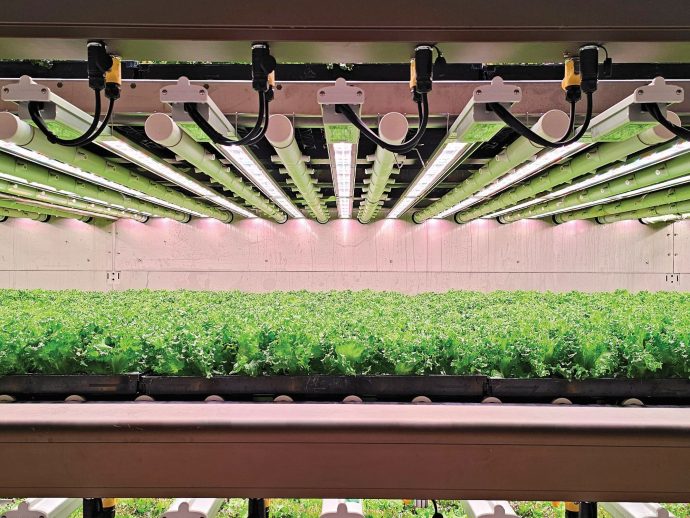
Vision Greens’ headquarters in an industrial park is filled with towers of hydroponic trays loaded with organic seeds grown by a computer-controlled system that regulates LED lighting, organic nutrients, reverse osmosis water filtration, air flow, and carbon dioxide levels to meet crop needs. The result: perfect, nutrient-dense lettuce harvested every 26 days, winter, spring, summer, or fall.
Those crops are perfect because they aren’t exposed to insects, disease, or weather fluctuations, eliminating the need to spray.
Harvests are delivered to a warehouse, often on the day they’re picked, 76 km away. Meanwhile, most conventional and organic romaine sold here must travel more than 4,300 km from California’s Salinas Valley, where growing and shipping conditions vary and make produce vulnerable to dangerous bacterial contamination.
The very nature of their production and transport methods means Vision Greens lettuce will never have to be pulled off store shelves in the name of safety. And with plans to build one-acre vertical farms elsewhere in Canada that have 60 times the growing density and 135 times greater crop yield than field lettuce, the company is poised to play as significant a role in building secure local food systems as Deep Roots Farm.
By Tiffany Mayer
Article Courtesy of Alive Magazine