Category: Sustainability

  • The upside of food upcycling

    The upside of food upcycling

    The upside of food upcycling

    Saving food waste while saving the planet and boosting your health

    WA whopping 58 percent of all food produced in Canada is lost or wasted every year. A third of those 35.5 million metric tonnes of wasted food could be rescued. Innovative Canadians are making a difference, working to eliminate food waste, protect the environment, and feed our communities—all through the power of upcycling.

    What’s up with upcycling?

    Unnecessary food wastage happens every step of the way between the farm and your fridge.

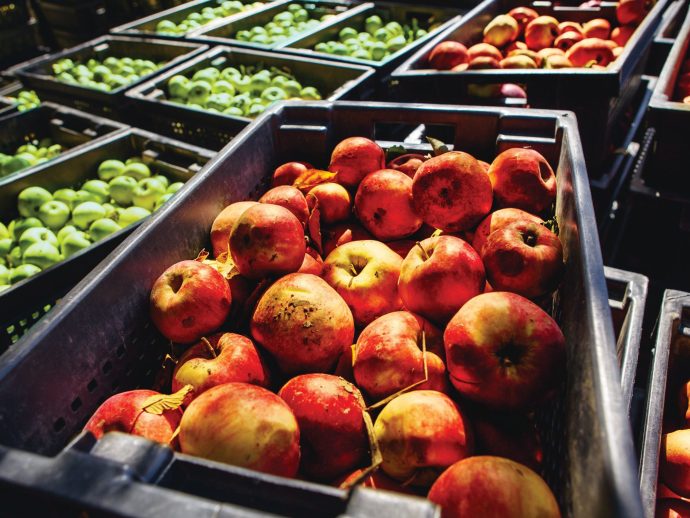
    At the farm, surplus fruits and vegetables, as well as those that may be misshapen or “ugly,” are discarded or left to rot. Then, during manufacturing and processing, 20 percent of food is lost or wasted. A lot of that is due to discarded byproducts or parts of the raw ingredient that are not needed in the final manufactured product.

    Upcycling aims to change that, transforming unwanted food or food manufacturing byproducts into something useful.

    “The concept of upcycling is really about extracting every last bit of value that you can from a natural resource,” explains Shelley King, CEO of Natural Products Canada, an organization that works to identify and invest in innovative solutions in the natural products industry.

    “When we upcycle any material, we’re reducing the number of resources needed to create a new item,” King adds. “In the case of upcycling food, we’re addressing the huge challenge of feeding the world without putting more strain on the planet.”

    How upcycling works

    From coast to coast to coast, Canadian farmers and food manufacturers are finding creative ways to transform previously unwanted food ingredients into nourishing, high-quality foods and supplements.

    It’s all about looking at where food wastage is happening and then applying out-of-the-box creativity.

    Take potatoes, for instance. Spuds are the most widely grown vegetable crop in Canada, making up nearly a third of all farm sales last year.

    “When you’re processing potatoes to make French fries or other potato products, you use water, and the water becomes super concentrated in starch,” says Cara Kennedy at Solnul, a supplement company based out of Carberry, Manitoba. If you’ve ever cut a potato and noticed the white powder on your cutting board after the potato water evaporates, that’s what she’s referring to.

    Solnul’s shareholders were originally potato farmers who now own a starch plant. “They had the foresight to do microbiome research on the starch,” says King, and multiple clinical studies showed how this potato starch was an effective prebiotic (helping to feed the healthy bacteria in your gut).

    They’ve turned that starch—which would otherwise have been discarded—into a research-backed prebiotic ingredient that you can now find in protein powders, protein bars, and other health foods.

    “Canada is the bread basket of the world, and there are a lot of opportunities for upcycled ingredients,” adds Kennedy, who is quick to point out that we shouldn’t be worried that upcycled foods are somehow inferior. “It’s all about how to use every part of an ingredient to its highest and best value.”

    By Joshua Duvauchelle

    Article Courtesy of Alive Magazine
  • Currents in aquaculture

    Currents in aquaculture

    Currents in aquaculture

    Solutions are needed to support research, technology, and social influence

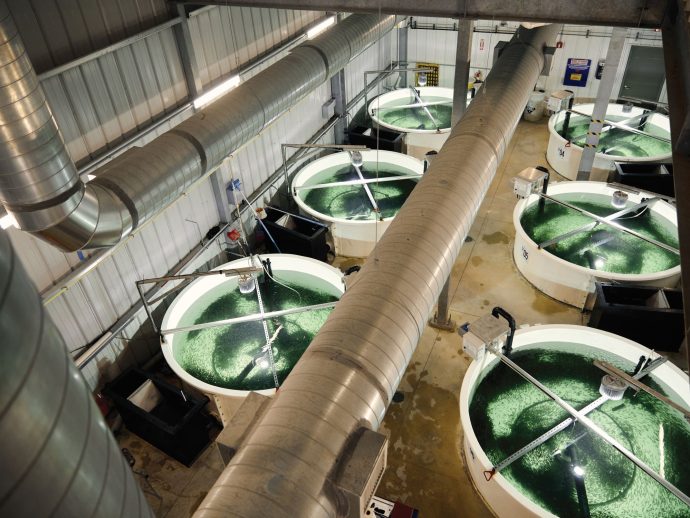
    The seemingly straightforward definition of aquaculture—the cultivation of aquatic organisms in water environments—has a web of history, controversy, and complexity beneath it. It addresses critical issues facing the environment today.

    In the beginning

    Aquaculture is not new. Evidence of various forms dates back millennia, though large-scale commercial fish farming became prominent in the mid-20th century. Initially, aquaculture served recreational purposes, with publicly funded hatcheries producing sport fish like trout and bass for stocking waters.

    As the world’s population grew and demand for fish and shellfish increased, pressures on certain species intensified. This led to a significant shift in the mid-20th century, giving rise to a new industry focused on food production.

    Feeding the masses

    The first commercial aquaculture efforts in the US began in the 1950s, spreading globally in the 1960s and ’70s. However, this growth brought environmental issues: shrimp farms in Asia destroyed mangroves and polluted waterways, and open-net pens for salmon threatened local ecosystems.

    Other challenges included untested management practices and dealing with unforeseen consequences. Advances in technology, better management, and regulations have addressed some of these problems, but many issues remain.

    Pushing forward

    Two of the companies at the forefront of that movement are LocalCoho and Bluehouse Salmon. Both are braving uncharted waters to find solutions.

    For these innovators, the central challenge lies in striking a balance between meeting rising global demand for seafood and reducing the environmental impact of production. Climate change adds another layer of complexity, raising questions about whether historically well-suited ocean regions will remain viable for open-net pen farming in the future.

    This is why land-based aquaculture is increasingly seen as a promising alternative—one that avoids operating “in the commons” of the ocean and reduces reliance on government consent for offshore sites. Despite the hurdles, both companies are motivated by the opportunity to transform aquaculture into a more sustainable and resilient industry.

    Another perspective

    Patagonia Provisions, part of the environmentally focused Patagonia, promotes eating lower on the food chain to reduce the impact on larger species like tuna and salmon. They offer products featuring species such as mackerel, anchovies, and pink salmon, supporting traditional, sustainable, local farming methods that benefit communities and the environment.

    Learning and choosing

    Consumers play a key role in supporting sustainable seafood. Learning from organizations that monitor and analyze industry practices helps. Certifications like those from the Aquaculture Stewardship Council indicate responsible farming practices.

    The Monterey Bay Aquarium’s Seafood Watch program offers current data on sustainable seafood options worldwide. Their standards are based on science and collaboration, setting a high bar for environmental responsibility.

    A look ahead

    Aquaculture’s role will only grow; it is the world’s fastest-growing food sector and essential for future protein needs. It supports global food security but also raises questions about environmental sustainability.

    Can we feed the world while protecting the environment? The ongoing search for solutions continues.

    By Neil Zevnik

    Article Courtesy of Alive Magazine

  • Understanding sustainability

    Understanding sustainability

    Understanding sustainability

    Going beyond the buzzword

    The planet is heating up, putting life and ecosystems at increasing risk. Social and economic inequalities, between and within countries, remain stubbornly high. We’ve all heard the buzzword “sustainability” given as a solution to these problems: if we can shift our systems to become more sustainable, we can cut down on carbon emissions and resource use while making societies fairer for all.

    However, what does sustainability actually <mean>, and what progress are we making towards it?

    Unpacking sustainability

    In 1987, the United Nations Brundtland Commission defined sustainability as “meeting the needs of the present without compromising the ability of future generations to meet their own needs.” This definition is still relevant today. Indigenous communities have long held the belief that we should care for our world in a way that ensures the well-being of future generations.

    Core components of sustainability

    The concept of sustainability has three core components:

    • environmental sustainability
    • economic sustainability
    • social sustainability

    Environmental sustainability

    Environmental sustainability focuses on protecting and preserving natural resources (like clean air, water, forests, and biodiversity) for future generations. Shifting toward renewable energy and reducing waste are key aspects.

    The environment and the economy

    Economic sustainability means supporting growth while ensuring resources are used efficiently and responsibly. Our largely linear economies follow a “take-make-use-dispose” formula. While we’ve shifted toward recycling, efforts are often insufficient: a 2019 study found only 9 percent of plastic waste in Canada is recycled. To be truly sustainable, we need a circular economy, where products and resources remain in circulation. Just 7.2 percent of the global economy is currently circular.

    Social sustainability

    The social dimension of sustainability is critical, relating to creating a world where everyone can meet their needs and access a good quality of life. This includes ensuring equity in transitions to more sustainable practices.

    Environmental justice

    Environmental justice highlights how vulnerable communities often bear the brunt of climate change and pollution. The Government of Canada is working on a strategy to promote environmental justice.

    Working toward a more sustainable world

    While individual action is important, governments and corporations also have a lot of power.

    Government commitments and action

    In 2015, Canada committed to the UN’s 17 Sustainable Development Goals (SDGs) to be achieved by 2030, covering environmental, economic, and social sustainability. While progress is being made, much work remains, particularly regarding persistent inequalities and increasing emissions from oil and gas projects.

    Corporate influence and power

    According to a recent study, 80 percent of global carbon dioxide emissions from 2016-2022 came from just 57 corporate and state producing companies. Corporations hold significant influence and often lobby against environmentally and socially beneficial practices.

    Individual agency

    Systemic change is needed, but individuals also have power. Be critical of corporate sustainability claims, as “greenwashing” is common.

    We should all try to make our lives sustainable, but don’t lose sight of the changes needed from governments and corporations. Using your voice to protest and vote are crucial ways to hold power to account.

    By Isabela Bonnevera

    Article Courtesy of Alive Magazine

  • Give yourself a financial health checkup

    Give yourself a financial health checkup

    How to improve your financial fitness

    If your bank balance isn’t trending in the right direction, or if you just want to bump it up a notch, you’re probably due for a financial health checkup. Here’s your road map to a healthier financial future.

    More than just money

    Getting a handle on your financial well-being does a lot more than boost your bottom line: it inevitably spills over into your physical and mental well-being. A reduction in stress related to financial issues leads to better sleep, increased energy, improved relationships, and stronger mental and emotional health.

    Where to start

    Steve Bridge, an Advice-Only certified financial planner, says one way to take the pulse of your financial health is to track your net worth monthly for a year, then moving toward quarterly and then semi-annual tracking. Your net worth is your assets (everything you own) minus your liabilities (everything you owe).

    “If your net worth is trending upward, you’re on the right track,” says Bridge. And if it’s not, you should find out why. This often comes down to simply making more or spending less, says Bridge. It also helps to craft a forward-looking budget.

    “Expense tracking is great, but it looks backward,” says Bridge. To make a forward-looking budget, you’ll want to open multiple free savings accounts for specific purposes, including travel, clothes/gifts, house expenditures, and so on. Put money in each of these categories monthly. Spend whatever is in the designated category’s account, but no more than that, says Bridge. That way, you’re never going into debt to buy anything.

    Inquire about your investments

    Check your investments once or twice a year. They should be the same or better than the relevant benchmark, says Bridge. If your investments are trailing those relevant benchmarks, ask your investment advisor why.

    According to Bridge, it’s also important to ask about the fees you’re paying on your investments, as they can have a major impact on long-term wealth. Everyone pays fees, says Bridge. However, these fees are often hidden. You should be paying less than 1 percent in investment fees.

    Don’t hesitate to ask your investment advisor questions. “No one cares more about your money than you do,” says Bridge. “If anyone makes you feel dumb when asking your questions, take your money elsewhere.”

    Managing your mental health in the meantime

    What should you do when there’s no quick fix to your financial stress? Amanda Kruger, a licensed professional counselor specializing in financial trauma and working through money stress, offers these suggestions.

    1. Make a plan and follow through with it. For instance, make a debt repayment plan or a plan for how to prioritize your money.
    2. Keep in mind that money is a renewable resource. There’s always money out there, and you’re fully capable of making more of it.
    3. Remember your self-worth is not equivalent to your net worth.

    By Carimé Lane

  • Broccoli Stem Stir Fry

    Broccoli Stem Stir Fry

    Broccoli Stem Stir Fry

    Thanks to Christine Waltermyer & The Natural Kitchen Cooking School!

    Christine Waltermyer is a local and renowned Wellness Chef, private chef to celebrities, published cookbook author and founder of the Natural Kitchen Cooking School, which offers an online Plant-Based Cooking Program. She also loves shopping at Basil Bandwagon! Visit naturalkitchenschool.com to subscribe to her email newsletter for new recipes, tips, and FREE access to the Power of Veggies mini-course!


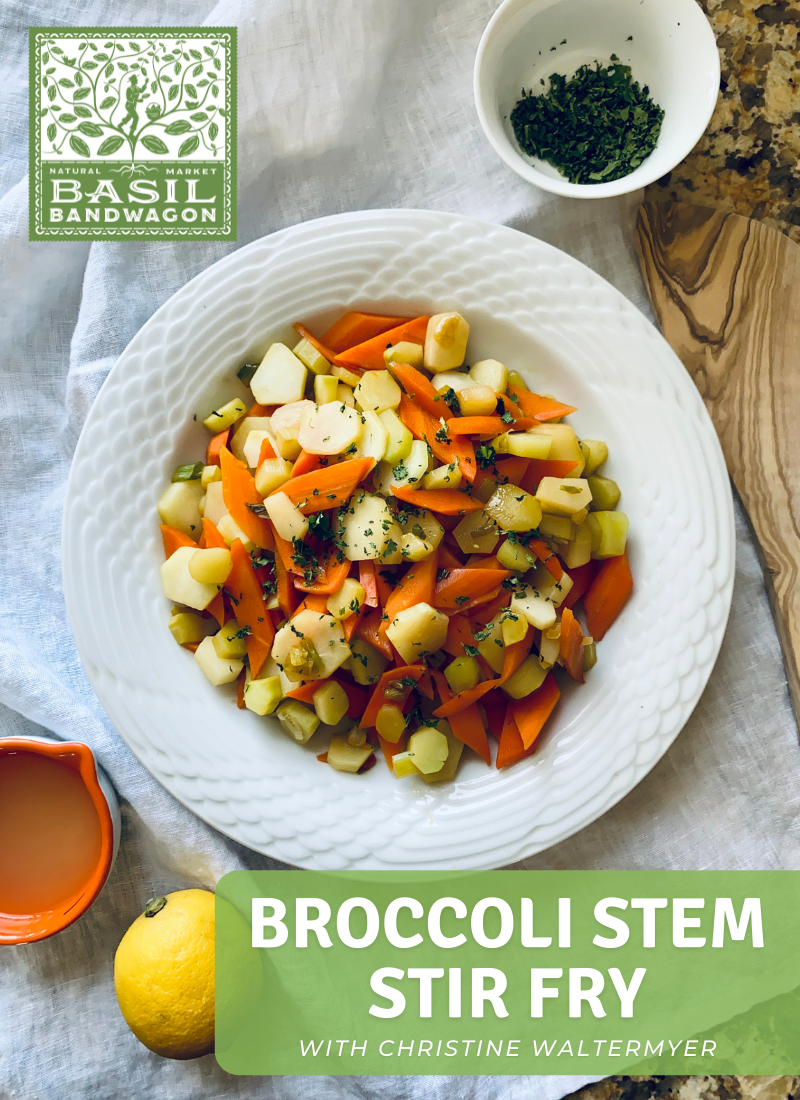
    Happy Earth Month! Let’s talk about food waste. Did you know every year, each American throws out about 1,200 pounds of organic garbage that could be composted? There are other ways to decrease this amount (other than simply composting). One way is to use your food scraps to make another recipe! Check out this Earth friendly Broccoli Stem Stir Fry recipe thanks to Christine Waltermyer and The Natural Kitchen Cooking School. All ingredients can be found at your local Basil Bandwagon Natural Market.

    Broccoli Stem Stir Fry

    Course dinner, entree, Lunch
    Keyword dinner, entree, lunch, stir fry
    Servings 4

    Ingredients

    • 2 cups carrots sliced into rounds or "lozenges" (I refer to this as the ribbon cut in my video)
    • 2 cups peeled broccoli stems sliced
    • ½ cup scallions sliced
    • ¼ cup broth
    • 2 tablespoons coconut aminos
    • 2 teaspoons lemon juice
    • 1 tablespoon maple syrup
    • Sea salt to taste

    Instructions

    • Heat a large skillet over medium high heat. Add the broth and heat it briefly.
    • Add the carrots and a few drops of the coconut aminos. Cook and stir for a minute or two. Add the broccoli stems. Cook and stir for another minute or two.
    • Add the remaining coconut aminos, scallions, maple syrup, and lemon juice. Cook and stir for a minute. Cover and cook for a few more minutes. Continue cooking to your desired tenderness. Depending how long you cook this, you may need to add a splash of water or more coconut aminos to prevent the vegetables from sticking to the pan. If needed, adjust seasoning to taste by adding a little more seasoning.
    • Plate and serve warm. Enjoy!

    Thank you to Christine Waltermyer and the Natural Kitchen Cooking School for working with us to help promote healthy, nutritious meals and products that are affordable, full of nutrients, and simple to make at home!

  • Qure Water

    Qure Water

    Qure Water believes that an active lifestyle, proper hydration, and natural nutrition are crucial to good health, happiness, and a balanced life. Thus, Qure set out to achieve an exceptional pH of 10, allowing one to completely hydrate, restore, and re-energize oneself. Qure is the ultimate alkaline water, as the pH of 10 has many health and hydration benefits.

    Qure’s hydration concept is simple: to make a high pH water that is only made with super clean base water and infused with natural ionic alkaline minerals. They decided that the best way to do this would be to research how Mother Nature naturally mineralizes it’s spring water and replicate this process. By creating a big portable clean room with reenacting rain and the pressure, Qure figured out a way to simulate nature in a large box. This Quration process is something that has never been done before in the water industry and thus sets them apart from their competitors.

    Qure constantly strives to provide optimal health benefits, as well as a consistent pure, clean, and refreshing taste.

    Come into any one of our Basil Bandwagon Natural Market locations to Qure Your Thirst – on sale through July 31, 2021. For more information on Qure Alkaline Water, please visit https://qurealkalinewater.com/ .

    Resources:
    https://qurealkalinewater.com/
    https://qurealkalinewater.com/who-we-are/
    https://qurealkalinewater.com/explore-qure/the-science/
    https://qurealkalinewater.com/qure-alkaline/

  • A Delicious New Partnership with Unionville Vineyards

    A Delicious New Partnership with Unionville Vineyards

    If you’ve never had the Buffalo Tofu at Basil Bandwagon Natural Market with a glass of Unionville’s Estate Blush, you are missing out on one of the great food & wine pairings of the world! I’m really excited to share the news that almost the full portfolio of Unionville wines can be purchased now at each of the Basil Bandwagon locations- Lambertville, Flemington, and Clinton. These are terrific places, equal parts grocer, prepared foods counter, and vitamin & supplement shop. The stores focus on organic, local, fresh, and healthy foods. Their Farm to Market Café always has amazing offerings, and their specialty juices and smoothies are always rotating and delicious. You could visit for a sandwich, a cup of coffee, a pint of local ice cream (I’ve spied offerings from The Bent Spoon in the freezer), or do your entire week of grocery shopping. Now, you can stock up on wine for dinner or the weekend too.

    Here are a few pairings that Purchasing Director Katrin Alampi and I pondered upon. You can find these items at the Café counter in each store, and these wines are all stocked there too. Enjoy! 
    – John Cifelli, GM

    Mushroom Turkey Burgers: local turkey, mushrooms, onions, garlic, oats
    pair these with the Silver Lining Cabernet Franc. This fruity, medium-bodied red will bounce off the savory, umami flavors of the burger. Skip the ketchup, let the wine play that role.

    Lemon Kale Quinoa Salad: quinoa, root vegetables, kale, olive oil, lemon juice
    pair with Pinot Grigio. This is a fun one because root veggies and kale are challenging wine pairing partners. Our Pinot Grigio is textured and zippy, the acidity acts to wash and refresh the palate. 

    Falafel with Tahinispicy chickpea patty served with housemade tahini
    pair with Estate Blush. When you build a cheese board, you often find fruits and nuts together as accompaniment. The fruity blush wine and the nutty character of falafel and tahini are lovely together, and the touch of sweetness to the wine balances the spice of the dish.

    Black Bean Burgerblack beans, brown rice, corn, bell peppers, onion, garlic, cumin 
    Pair with Revolutionary Red. This burger packs a punch of flavor, and the medium to full bodied Revolutionary Red matches it in weight, fruitiness, and intensity.

    Chicken Saladshredded organic chicken, mayo, celery, onions, stoneground mustard
    Pair with Estate Chardonnay. I consider myself to be somewhat of a chicken salad aficionado. Why most places want to clobber theirs with mayonnaise confounds me. Basil’s is perfectly balanced, and the sweet, salty, and savory flavors are wonderfully complimented by the tropical and citrus fruit character of our Chardonnay. Have this on toasted multi-grain to take it to the next level!

  • Reduce, Reuse, Recycle!

    Reduce, Reuse, Recycle!

    It’s time to hop on the bandwagon and start living your sustainable lifestyle! Reduce your waste footprint, reuse what you have, and recycle what you don’t need anymore. Every little bit helps you and the Earth stay healthy and happy.

    Check out some awesome ways Basil Bandwagon can help you jumpstart your new lifestyle below! BONUS- today only (Friday 4/26/19), all reusable products (i.e. Hydroflasks, Ukonserve containers, Stasher, Lifefactory bottles, Conscious Cutlery, and more!) are on sale for 20% off! DOUBLE BONUS- if you forget your shopping bag take one from our Bag Tree or if you have extras, leave them for someone else to use.

    Buy in Bulk

    Start small and work your way up! We carry a large assortment of teas, herbs, grains, coffee, snacks, and more in our bulk section. You can even use your containers from home (just make sure you weigh them at our cash registers before filling them with product)! Don’t have any at home? No worries, we carry all shapes and sizes of bulk containers for purchase!

    Stay Hydrated

    Everyone has their specific “cup of tea.” Whether you drink coffee, tea, water, or kombucha, look no further for your bottle of choice! We have a large assortment of sustainable drinkware- including stainless steel straws, straw cleaners, and awesome tea infusers!

    A Foodie’s Heaven

    Don’t forget your lunch! We carry containers of all shapes and sizes to pack your healthy meals in. Are you a meal prepper? The Stasher is a perfect product as you can cook, store, and freeze your meals for as long as you like!

    On-the-go? Say no more!

    If you are constantly traveling, make sure you always carry these necessities. Squeezable containers for your shampoo and conditioner, essential oil bottles, produce bags, assorted size bags for makeup and jewelry, and reusable storage bags are perfect for your suitcase.

    Package Free Goodies

    Have you checked out our package free soap from Zum Bar? This awesome goat’s milk soap comes in a variety of scents and is perfect to try before you buy their entire line! At $1.49 per ounce, you can’t go wrong!


    Regardless of how you live your sustainable lifestyle, let us know! Leave us a note, email us, or tell us in person! #basilbandwagoncares

  • Plastic Bags: Putting an End to the Bag Monster We’ve Created

    Plastic Bags: Putting an End to the Bag Monster We’ve Created

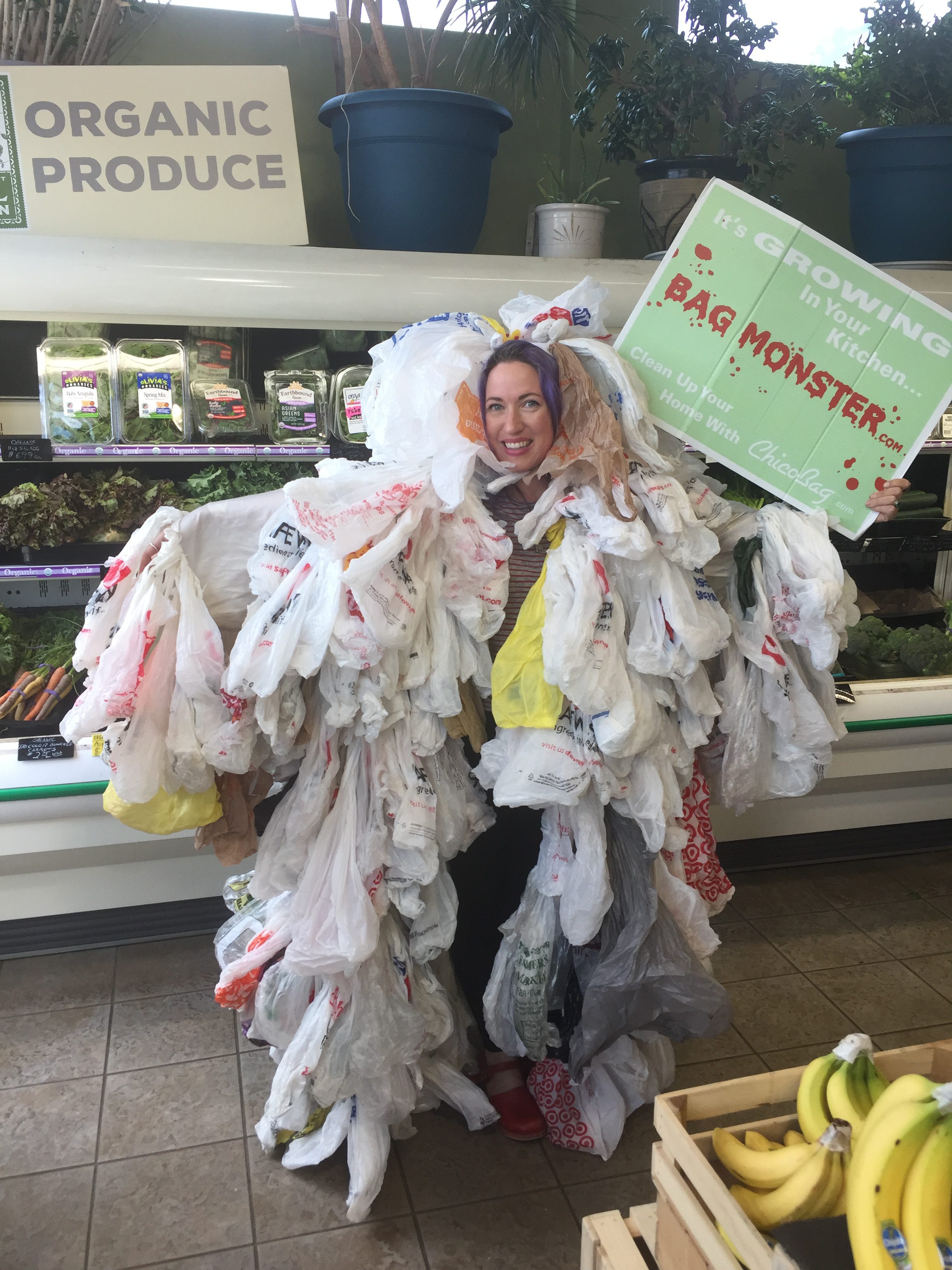
    Check out this fancy outfit! Slimming, isn’t it?

    But for real, Carolyn is shown here sporting a handmade jacket and hat of retail plastic bags. 500 of them, to be exact! Why is she wearing this? Well, besides to get a laugh out of all of us, she’s wearing it to demonstrate the amount of plastic bag waste ONE PERSON generates in A SINGLE YEAR.

    Imagine 7.6 billion plastic-bag-wearing-Carolyn’s wandering around. (That’s the current number of us inhabiting our Earth.) The amount of waste is almost unfathomable.

    Of course, the moral point here is that we should all be using reusable bags and/or reusing the plastic bags that are already out there.  You already know that. What we all need to be doing at this point is practicing what we preach, spreading the word by creating and sharing impactful messages (like Carolyn’s outfit), and cleaning up our act.

    Here’s some more information to get you further inspired to take action:

    A big ‘thank you’ to our friends at Chico Bag for this eye-catching/opening costume. #ChicoBags supply us with our own custom-branded beautiful Basil Bandwagon reusable bags that fold up nicely and fit in your pocket or purse. Purchase them at both of our locations.

    Or choose one of our classic Canvas bags!

  • Love Food, Hate Waste!

    In honor of Earth Week, our 25th Anniversary, and EarthFest right around the corner, we’d like to share a dozen ways we help reduce waste (just giving ourselves a little pat on the back since we’re proud of our efforts!):


    reusable canvas bag

    Reuse those bags! We offer a discount for use of your own bags for carrying away your groceries. But don’t stop there – skip the plastic bags in the produce aisle and opt for reusable bags for your apples, brussels sprouts, lettuce, and all the rest! We sell reusable mesh bags that are perfect for produce.

    bulk bins flemington

    Buy in bulk: You can choose to put your bulk beans, snacks, and other goodies straight into containers you bring from home. Just ask one of our cashiers to weigh your container before you fill it. Mason jars and other leftover jars are great for this.


    Buy only what you need: Speaking of bulk, buying just what you need means you’re less likely to have to throw away food down the line! We sell bulk medicinal herbs, spices, grains, beans, trail mixes, dried fruit and granola to name just a few.

    bathroom stall doors Flemington

    Support recycled goods: Have you noticed the bathroom stalls in our Flemington location? They’re made out of milk bottles and lids, giving them a cool rainbowed-confetti look! We’ve incorporated reused material throughout the stores, diverting waste from landfill and making good use of it.


    Buy in recycled bottles: We sell Eagles Peak Water. This company picks up, sanitizes, and reuses their glass bottles. When you purchase, you pay a $2 deposit for the bottle and get that refunded to you upon your bottle return to our store. The convenience of bottled water without the waste!

    Hyroflask

    Use your own cup ‘o joe: Bring in your own cup for your coffee, smoothie or juice and our cafe crew will happily serve you your favorite refreshment to go. If you don’t have one yet, we recommend our Hydroflask double walled coffee containers for that java on the go experience.

    biodegradable compostable bags

    Shop with better bags: If you forgot your bags today, don’t worry. Our new plastic bags are fully compostable.  

    terracycle

    Recycle your product packaging: Check out our Terracycle collection boxes. This innovative local business is finding recycling methods and uses for trash that isn’t widely recycled (check out the photos of bags made from some of our favorite product boxes!). Bring us your trash to be made into treasure! Find out more at www.terracycle.com


    Buy recycled: We offer a great range of recycled paper products. Try the coffee filters, then add them to your own compost right along with the leftover grounds.   

    Compost: Starting your own compost pile at home is another great way to cut down on waste- plus it makes for nutrient rich dirt for your plants!  All our Farm to Market Café scraps are composted, and unsaleable produce is collected by Woodlands Wildlife Refuge for their resident critters to enjoy.


    Ditch disposable lunch and snack bags: Single-serving packs and plastic bags can be handy when brown bagging lunch or snacks, but they create more waste than you need. We have metal, glass, and silicone lunch container options. Check out our reusable bamboo cutlery too!


    Sip through stainless steel straws: We sell stainless steel straws which are a great reusable plastic-free option. One of our next big projects is reducing plastic straw waste from our cafe.

    We welcome your feedback on how we can help cut down our waste and help make it easier for you to do the same at home! Leave us a comment below or write to us 🙂