Blog

  • Better for one, better for all

    Better for one, better for all

    Reusable cups that help curb the spread of microplastics

    The problem with plastic

    Microplastics have also been found in soil ecosystems, potentially compromising crop health. Because microplastics can release harmful pollutants, we are seeing worldwide effects of the damage they can do to our oceans, lands, and air—and the materials we consume from those sources.

    The human cost

    As devastating as microplastics are for Mother Earth, they also pose a significant threat to human health. These particles find their way into our bodies through various channels, including food like seafood and honey, bottled water, and even the air we breathe. Microplastics have been found in human blood, breast milk, livers, and kidneys.

    While we are still learning about the effects of microplastics on human health, the initial research has been alarming. A 2023 study found that microplastics “can interfere with important biological processes in the human body and can cause disruption of the endocrine, immune system; can have a negative impact on mobility, reproduction and development; and can cause carcinogenesis.”

    A 2025 report from the University of New Mexico Health Sciences found that microplastics in human brains have increased 50 percent over the past 8 years, and dementia patients had 10 times as many microplastics present as the general population.

    Better for one, better for all

    One company that is stepping up to tackle the plastics problem is Better for All. Better for All has developed a reusable and biodegradable cup that is designed to replace single-use plastic cups.

    Their solution to the problem of single-use plastics lies in PHA (polyhydroxyalkanoate), a material that is reusable and non-toxic, can sustain heat up to 212 F, and is at-home compostable. This unique material is known as a biopolymer, which is a biomaterial made by living fermentation microorganisms.

    The main stage

    According to one watchdog publication, an average stadium uses 800,000 plastic cups for a year’s worth of concerts, and 571,659 cups throughout an NFL season. The Oak View Group, which founded a sustainability network that includes sites like the Prudential Center, Dodger Stadium, Fenway Park, Wrigley Field, and Citi Field, says that their members “currently divert an average of 32 percent of their waste through reusing, recycling, and composting.”

    With the addition of Better for All’s compostable cups, venues can see a major change in their microplastics contribution, without asking attendees to alter their behavior (or their favorite gametime beverage). The next time you see your favorite artist play a concert, or root for your home team at a game, you may be able to cheers to something pretty impressive—sustainability.

    By Laura Bolt

    Article Courtesy of Alive Magazine
  • Rest up

    Rest up

    It’s Rest and nonrest

    According to research, the state of rest doesn’t occur from the activity itself, but rather from when there is harmony between our feelings, motivations, and actions. This harmony cultivates calm, confidence, and belonging. By contrast, the state of nonrest is defined by <dis>harmony of our feelings, motivations, and actions, which leads to tension and energy depletion.

    We are continuously moving between rest and nonrest. When we feel tense and fatigued, we should take it as a cue to restore harmony.

    Keys to foster rest

    We can cultivate harmony between our feelings, motivations, and actions by embracing the following concepts.

    Natural rhythms

    Align with the natural rhythms of the day, month, and season. For example, take a rest as you transition from one task to another in the day and honour how you feel in the winter versus the summer.

    Letting go

    You don’t have to do everything yourself. Trust and have confidence in others, allowing them to help you.

    Safe relationships

    Being accepted without judgment and not having to behave in a certain way is conducive to rest. Invest your time and effort into beneficial relationships and walk away from toxic ones.

    Pleasure and creativity

    Appreciate the beauty in nature, music, and art. Take the time to not only to take in and enjoy the beauty, but to also answer the call to create what you’re compelled to create.

    Feeling rested

    Mental-emotional health

    We feel mental fatigue after prolonged periods of cognitive activity. Mental fatigue is a psychobiological state involving cognitive decline, reduced accuracy, and slower reaction time. Symptoms may include temperamental depression, moodiness, and changeability, which may create relationship difficulties and challenges at work; it can sometimes lead to substance abuse.

    Rest Rx: Research shows that listening to music and binaural beats helps ease mental fatigue. Having a regular meditation practice may also reduce the negative effects of mental fatigue.

    Physical health

    When we’re physically fatigued, we can experience symptoms ranging from insomnia, chronic pain, digestive issues, heart conditions, and gynecological problems. While there isn’t a biological explanation for every physical symptom of fatigue, researchers have developed an umbrella term for exhaustion-related symptoms, called persistent physical symptoms (PPS).

    Rest Rx: Research shows that nonsleep deep rest (NSDR) improves physical readiness, exercise recovery, tension, emotional balance, negative affect, and overall stress. In this study, the NSDR was elicited by lying down on a mat in a dark, quiet room and doing 10 minutes of guided meditation exercises.

    By Cassie Irwin, ND

    Article Courtesy of Alive Magazine
  • Meditation, mindfulness, and mental health

    Meditation, mindfulness, and mental health

    Combatting the loneliness epidemic

    What if you could be even 1 or 2 percent happier?

    Meditation, even for a few minutes at a time, can be hugely beneficial.

    You are not alone in being lonely

    The extent of mental illness has disproportionately increased post-COVID. The pandemic forced people who were already experiencing stress into isolation, and loneliness is a breeding ground for anxiety.

    Loneliness has become the biggest epidemic that the world is facing. We spend more time on the internet scouring the news, which is negative. It makes us feel even more lonely because we fear that nobody cares for us—which is unfounded— and that loneliness just pervades.

    Mindfulness, one type of meditation, can be an elixir. It’s interesting to understand why it is necessary and why it works.

    Pay attention to what you pay attention to

    The brain wants to put as much as possible into the unconscious, which helps you to get through life quickly. But that knowledge base is marked by emotions.

    This accumulation of unacknowledged emotions can be manifested as forms of stress. This is where mindfulness can be helpful as a method of recognizing and slowing that process.

    Mindfulness is the deliberate, intentional focus in a nonjudgmental way. By being aware of how crucial your attention is, you can understand that <where> you put your attention has an impact on who you are and—more importantly—who you’re going to be.

    This is the first step toward a meditation practice. Without self-awareness you’re a cork in the ocean. By paying attention deliberately, and being aware of more positive things, you’re creating a future for yourself that’s going to be more positive, and one you’re more connected with.

    Breathe through it

    calm and control your breathing is a powerful tool. We can use the breath to control our anxiety and our mood.

    Try the pranayama breathing technique or joining a yoga practice at a local community centre—readily available and inexpensive—since this also combats loneliness.

    The admonishments to “keep in shape” and “stay healthy” are associated almost solely with our bodies from the neck down. But the benefits of being mindful, and learning to calm and relax our thoughts, are incontrovertible.

    Therapists use the “thought train” analogy: you are a passenger on a train; the passing landscape represents your thoughts. Allowing the thoughts to simply pass by, without judgment, is the essence of mindfulness, and the seed of meditation.

    What self-care really means

    Research has consistently shown that mindfulness improves brain volume, increases the grey matter, lessens the chances of dementia, and reduces depressive symptoms and anxiety. There are cardiovascular benefits: reducing chances of stroke and heart attacks, and immune function increases.

    By Kenny Bodanis

    Article Courtesy of Alive Magazine
  • Lemon Chicken and Greek Salad Skewers

    Lemon Chicken and Greek Salad Skewers

    Lemon Chicken and Greek Salad Skewers

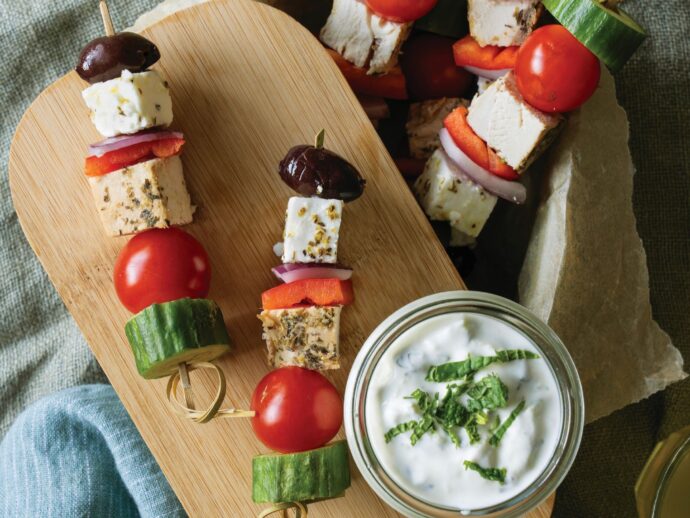
    The inspiration here is Greek Salad―but on a stick. We’ve added some savoury lemony garlic chicken packed with flavour so it’s delicious served cold. These skewers are packed full of veggies, which makes them easy to modify for those with dietary preferences. Just leave off the feta or the chicken for those who prefer veggies only. And while they’re delicious as is, the inclusion of a tzatziki-style dip adds an extra zing. To keep things on schedule, cook the chicken the day before or early in the morning of your picnic.

    Lemon Chicken and Greek Salad Skewers

    Servings: 6

    Ingredients
      

    Lemon Chicken
    • 2 teaspoons extra-virgin olive oil
    • 1 tablespoon freshly squeezed lemon juice
    • ½ teaspoon Dijon mustard
    • 1 garlic clove peeled and minced or crushed
    • 1 teaspoon dried oregano
    • ¼ teaspoon dried thyme
    • teaspoon salt
    • teaspoon black pepper
    • 1 boneless, skinless chicken breast
    Skewers
    • 4 ounces feta cut into 12 bite-sized pieces
    • 1 teaspoon extra-virgin olive oil
    • ¼ teaspoon dried oregano
    • 2 mini cucumbers sliced into 12 pieces
    • 12 grape tomatoes
    • 12 bite-sized pieces red onion
    • 12 bite-sized pieces bell pepper in mixed colours
    • 12 pitted Kalamata olives
    • 12 wooden skewers
    Tzatziki
    • ¼ cup Greek yogurt
    • 1 tablespoon grated cucumber
    • 2 teaspoons lemon juice
    • 1 teaspoon finely chopped mint

    Method
     

    1. In glass container with fitted lid, whisk together olive oil, lemon juice, mustard, garlic, oregano, thyme, salt, and pepper. Add chicken breast, coating on both sides with the marinade. Seal container and refrigerate for 1 to 2 hours.
    2. When ready to cook, remove chicken from refrigerator and bring to room temperature while you preheat oven to 350°F. Bake chicken for 45 minutes, or until instant-read thermometer registers 165°F. Allow chicken to cool completely and refrigerate to chill for minimum 2 hours.
    3. In small bowl, dress feta with olive oil and oregano. Cut chicken into 12 bite-sized cubes. Assemble skewers by placing pieces of cucumber, tomato, a cube of chicken, red onion, pepper, feta, and olive on each skewer. Pack in airtight container and place in your cooler.
    4. Combine yogurt, grated cucumber, lemon juice, and mint. Add to small Mason jar with lid and pack in cooler or picnic basket. Bring a spoon so picknickers can drizzle the dressing over skewers.

    by Helena McMurdo

    Recipe Courtesy of Alive Magazine

  • Chickpea Flatbread Sandwiches with Arugula, Pomegranate, and Chili Crisp

    Chickpea Flatbread Sandwiches with Arugula, Pomegranate, and Chili Crisp

    Chickpea Flatbread Sandwiches with Arugula, Pomegranate, and Chili Crisp

    The simple presentation of these strawberry coconut cream pots hides sophisticated flavour. Ripe berries are macerated with a dash of sherry vinegar, maple syrup, mint, black pepper, and a hint of salt which helps to bring out the flavours. They’re then combined with coconut cream before being layered over a nutty buckwheat and almond base. Sealed up in Mason jars, they’re a cinch to pack and serve.

    Chickpea Flatbread Sandwiches with Arugula, Pomegranate, and Chili Crisp

    Servings: 6

    Ingredients
      

    Flatbread
    • 1 ¼ cups all-purpose flour
    • ¾ cup whole wheat flour
    • 2 tablespoons nigella seeds (kalonji)
    • ½ teaspoon ground cumin
    • ¼ teaspoon salt
    • ½ teaspoon honey
    • ¾ cup tepid water
    • ½ teaspoon yeast
    • 1 to 2 tablespoons canola or sunflower oil for cooking
    Chickpea filling
    • 2 tablespoons extra-virgin olive oil
    • 1 tablespoon red wine vinegar
    • 1 teaspoon honey
    • 1 teaspoon chili crisp
    • ½ teaspoon pomegranate molasses
    • 1 14-ounce can chickpeas
    • cup pomegranate seeds
    • Mint sprigs for garnish

    Method
     

    1. In medium bowl, whisk together flours, nigella seed, cumin, and salt. Set aside.
    2. In small bowl, whisk together honey and water and sprinkle yeast overtop. Allow to stand for 5 to 10 minutes, until yeast begins to bloom. Add yeast mixture to flour mixture and stir to combine.
    3. Knead by hand or use stand mixer with dough hook to knead for approximately 7 minutes, until dough is smooth and elastic. Place in oiled bowl, cover with kitchen towel, and set aside to rise at room temperature until doubled in size, about 1 to 2 hours.
    4. Divide dough into 12 sections and roll each into a ball. Heat griddle or cast iron frying pan and brush with oil. Roll out each ball to a flat circle and place down on hot surface. Flip when bubbles appear on top surface and bottom begins to brown, about 30 seconds to 1 minute. Flip to other side and continue to cook until surface is golden. Allow breads to cool and then pack in airtight container.
    5. In small bowl or jar, combine olive oil, red wine vinegar, honey, chili crisp, and pomegranate molasses. Set aside.
    6. To medium pot, add chickpeas and their water, plus an additional can of water. Simmer, covered, for about 15 minutes. Remove from heat, uncover, and allow to cool for 10 minutes before draining. Drain and toss with dressing and pomegranate seeds. Seal in container and refrigerate or pack in your cooler.
    7. To a separate sealable container, add 2 cups of arugula and pack in your cooler.
    8. To serve, have picknickers make up their own sandwiches, adding a little bit of arugula to a flatbread and topping with chickpea mixture. Top each sandwich with a few mint leaves.

    by Helena McMurdo

    Recipe Courtesy of Alive Magazine

  • Strawberry Coconut Cream Pots with Mint and Black Pepper

    Strawberry Coconut Cream Pots with Mint and Black Pepper

    Strawberry Coconut Cream Pots with Mint and Black Pepper

    The simple presentation of these strawberry coconut cream pots hides sophisticated flavour. Ripe berries are macerated with a dash of sherry vinegar, maple syrup, mint, black pepper, and a hint of salt which helps to bring out the flavours. They’re then combined with coconut cream before being layered over a nutty buckwheat and almond base. Sealed up in Mason jars, they’re a cinch to pack and serve.

    Strawberry Coconut Cream Pots with Mint and Black Pepper

    Servings: 6

    Ingredients
      

    • 1 tablespoon extra-virgin olive oil
    • ¼ cup raw buckwheat
    • ¼ cup blanched sliced almonds
    • ¼ teaspoon cinnamon
    • ½ teaspoon honey
    • 8 ounces strawberries washed and hulled, plus additional whole strawberries for garnish
    • 1 teaspoon sherry vinegar
    • 2 teaspoons maple syrup
    • ½ teaspoon freshly ground pepper
    • teaspoon salt
    • 20 mint leaves
    • 1 14-ounce can coconut cream chilled for 24 hours

    Method
     

    1. In skillet, combine olive oil, buckwheat, and almonds. Heat on low and toast for 7 to 10 minutes, stirring to ensure even browning, until buckwheat and almonds are lightly browned. Remove skillet from heat, add cinnamon and honey, and stir rapidly to coat. Set aside and allow to cool. Once cool, transfer mixture to bowl of food processor and blitz for a few seconds. Press mixture into 6 small Mason jars.
    2. Dice strawberries and, in bowl, combine with vinegar, maple syrup, black pepper, and salt. Add mint leaves and mash them with a muddler or back of wooden spoon. Stir strawberries and allow to stand for 20 minutes.
    3. Reserve and refrigerate about 1/2 of the macerated strawberries; add the remaining to blender jug. Open chilled coconut cream and scoop only firm cream into blender (reserve water for another use). Process until smooth and thick. Pour mixture over buckwheat layer in each Mason jar. Seal and allow to chill for 1 hour.
    4. Top cream pots with a layer of reserved macerated strawberries. Garnish each pot with an additional fresh strawberry and sprig of mint.

    by Helena McMurdo

    Recipe Courtesy of Alive Magazine

  • Invasion of the body snatchers

    Invasion of the body snatchers

    Invasion of the body snatchers

    Autoimmune diseases are on the rise (and what you can do about it)

    The rates of the most common autoimmune diseases, including type 1 diabetes, rheumatoid arthritis, lupus, and multiple sclerosis, are on the rise―but there is hope for prevention and management.

    What’s in the name: defining autoimmune diseases

    Autoimmune diseases happen when your immune system, which is supposed to protect your body from harmful invaders like viruses and bacteria, mistakenly attacks healthy cells.  This results in chronic inflammation and damage to various tissues and organs in your body, which can trigger an array of health concerns, like arthritis.

    Unlike other diseases caused by external factors, this immune malfunction makes autoimmune diseases harder to diagnose, as symptoms can overlap with many other conditions and vary widely from person to person.

    The causes of autoimmune disease

    Researchers continue to debate various questions about the underlying causes of autoimmune diseases like lupus and multiple sclerosis.

    Most theories boil down to two key factors: your genetics and your environment. Genetic triggers cannot be altered, but degenerative factors like exposure to toxic elements, infections, or chronic stress can be avoided with lifestyle changes.

    Optimize your diet

    Being overweight or obese raises your risks, so eating a healthy diet is foundational. Exactly what you eat is key, too. There’s a correlation between inflammation and both the development and the symptoms of autoimmune diseases.

    Concentrate on anti-inflammatory foods, including leafy greens, fatty fish, nuts, and seeds. That’s the focus of diets like the autoimmune protocol (AIP) diet, which has been shown to help with inflammation-linked health concerns. Reduce the intake of processed foods, refined sugar, and trans fats. Prioritize foods rich in probiotics such as yogurt and fermented vegetables, as well as prebiotic fibres, which help maintain the gut―an important factor in immune function.

    Sweat it out

    Research suggests that regular physical activity can help to both prevent and manage the inflammation and common symptoms, such as chronic fatigue, of autoimmune diseases.

    You don’t need to be a gym rat to reap the benefits. If you’re struggling with pain, mobility, or fatigue, gentle forms of exercise like yoga and tai chi can do the trick.

    When to talk to a doctor

    There are some situations where factors are simply out of your hands. But you’re still empowered to take control of your health. Regular monitoring can catch early signs if you’re at higher risk due to family history. Blood tests and symptom tracking can make a big difference.

    If you notice persistent symptoms or have a family history of autoimmune conditions, consult a healthcare provider. Early detection and management are crucial to improving your quality of life.

    by Joshua Duvauchelle

    Article Courtesy of Alive Magazine

  • The brain’s role in immune health and allergies

    The brain’s role in immune health and allergies

    The brain’s role in immune health and allergies

    The two systems are in constant communication

    The immune system

    Made up of structural barriers, organs, white blood cells, proteins, and chemicals, the immune system protects us from foreign antigens and helps our bodies heal from infections and injuries. To do this, the immune system and the nervous system maintain extensive and elaborate communication.

    This system has two pathways, a gas pedal (flight or fight pathway) and a brake (rest and digest pathway).

    We know that the brain influences the process of inflammation as part of the immune system’s fight against injury or infection. Too much inflammation can lead to problems, like chronic pain or diseases. The brain can help keep this in check, but, if it’s overwhelmed by too much stress or illness, inflammation can cause harm.

    What does the brain have to do with allergies?

    The allergic response

    In some cases, the immune system reacts by making antibodies to attack allergens that aren’t otherwise harmful. When someone with an allergy is exposed to the allergen, the immune system’s antibodies release histamine into the bloodstream that can cause symptoms, including inflamed skin, sinuses, airways, or digestive systems.

    Allergy symptoms can occur for the first time at any age, and can be affected by hormones, stress, smoke, medications, perfume, or environmental irritants. Some allergies can be outgrown, such as children’s allergies to certain foods. Airborne allergens can strike seasonally, during pollination, or year-round in the case of dust mites and animal dander.

    The brain’s role

    The brain plays a key role in the allergic response by directing the immune system how to respond. During times of stress, illness, or other factors, such as hormonal changes, our immune systems may be weakened, causing allergic reactions to be more severe.

    The brain’s inflammatory response to allergens becomes chronic with repeated exposures to the allergen, which creates long-term effects on the affected areas of the body, such as airways, eyes, and skin.

    Brain health ties to allergies

    Poor lifestyle habits—like lack of sleep, improper diet, chronic stress, and sedentary lifestyle—can lead to poor brain health, which, in turn, can result in higher sensitivity to allergens and more allergic reactions.

    Other strategies for maintaining the health of our brains and, thus, our immune systems include:

    • Engaging in regular exercise and physical activity
    • Avoiding excess alcohol, smoking, and other chemical exposures
    • Continuing to challenge our brains as we age by learning new things, staying socially engaged, and promoting new neural connections
    • Staying aware of the impacts that common diseases like high blood pressure, diabetes, and inflammation can have on brain health
    • Ensuring a well-balanced diet that avoids excess neurostimulants, like caffeine, and chemicals, and focuses on antioxidant-rich vegetables, healthy omega oils, and optimal hydration

    by Joanne Peters

    Article Courtesy of Alive Magazine

  • Homegrown garments

    Homegrown garments

    Homegrown garments

    Bringing textiles back to the land

    Contrary to appearances

    You wouldn’t know it to look at them, but our standard wardrobe picks leave a carbon-emissions wake larger than the aviation and shipping industries combined. Churning out the latest jeans or moisture-wicking shirts en masse takes a whole lot of water, chemicals, and underpaid labour—realities that go unseen by most of us in North America.

    Harder to ignore, since no body or waterway can escape it, is the problem of microplastics pollution caused in large part by polyester’s growing ubiquity in clothing.

    Consumers are purchasing at five times the rate they did two decades ago and tossing at a rate of one garbage truck every second. Not exactly a recipe for a livable planet or a fulfilling way to relate to our goods.

    Weaving an alternative

    Fibresheds are a response to this. Like a watershed, a fibreshed is a network of producers and processors supplying their region with local and sustainable garment materials.

    Pioneered in California in 2011, fibreshed organizations now exist across the US, Canada, Europe, and beyond. Everyone from shepherds, flax growers, and spinners to natural dyers, mill owners, and designers are collaborating to build a sustainable garment system that develops local livelihoods and stewards the air, land, and water.

    Tailored approach

    “Fibre,” under this model, might be linen (from flax), hemp, cotton, silk, hides, wool, or any other plant or animal material appropriate to the place and conducive to a “soil-to-soil” cycle. At this smaller, more intentional scale, seed varieties and animal breeds can be chosen for local hardiness and compatibility with the bioregion.

    Cultural fabric

    Fibresheds also help develop the deep repositories of skills and knowledge required to grow natural fibres and turn them into usable textiles. There is a need for infrastructure (small-scale mills, for example), and for human experience with different materials and processes―challenges that are best tackled collectively.

    The goal is to have thriving cottage industries and local economies, plus the resilience of knowing how to clothe ourselves sustainably amid whatever environmental, economic, or political disruptions occur.

    What you pay for

    The truth is that this “farm-to-closet” approach doesn’t come cheap. The first step toward affordability is, of course, to consume less. Mending and repurposing are equally essential.

    If you do invest in a wool sweater, linen pants, or a pair of buckskin moccasins made ethically from the land and people of your region, you’re bound to hold that item dear and, chances are, it will be a very long time indeed before you toss it. Even then, it can return to the soil with no harm done.

    by Jackie Skrypnek

    Article Courtesy of Alive Magazine

  • Underwater gardens

    Underwater gardens

    Underwater gardens

    Advocates are taking seaforestation efforts into their own hands

    Nurturing seafood to grow

    The objective of “Chiix̱uu Tll iinasdll: Nurturing Seafood to Grow” project, an initiative aimed at restoring an area of kelp forest in Gwaii Haanas between 2017 and 2021, was collecting urchins to help rectify the area’s unbalanced food chain. Sea otters were important consumers of urchins before their local extinction during the maritime fur trade of the 18th and 19th centuries.

    Without predation, urchins have become hyperabundant, leading to the overgrazing of kelp, an important cultural resource to the Haida Nation, as well as an integral component of the world’s biodiversity and environment.

    Kelp lives near shorelines around the world and helps to nourish and house important underwater life. Much like forests on land, kelp’s photosynthesis process absorbs carbon dioxide, nitrogen, and phosphorous and releases oxygen—an important system in slowing the rate of climate change.

    But the Haida Nation isn’t the only area grappling with kelp loss. More than half of kelp forests worldwide have declined in the past 50 years, jeopardizing coastal biodiversity, water quality, and atmospheric carbon levels.

    An overlooked issue

    Underwater gardens are disappearing at alarming rates due to factors like habitat destruction, overharvesting and overgrazing, and pollution. Other challenges include climate change and sedimentation caused by runoff from deforestation, dredging, or storms. And, while ocean conservation has been around for decades, kelp preservation and restoration are relatively new.

    A 2021 paper published in the Frontiers in Marine Science journal measured the invisibility of kelp forests in international environmental governance. Researchers found that for every mention of kelp forests, seagrass meadows were mentioned seven times, salt marshes 20 times, coral reefs 38 times, and mangroves 43 times.

    A global call to action

    In 2023, The Kelp Forest Alliance launched the Kelp Forest Challenge, a global movement calling on everyone—from individuals to corporations and governments—to join the challenge of restoring 1 million hectares and protecting 3 million hectares of kelp forest habitat by 2040.

    Measures to restore and preserve kelp forests begin with the identification of their causes for decline. Controlling urchin populations or cleaning polluted water and sedimentation can help conserve threatened kelp, while seeding or transplanting baby kelp can aid in the growth of new forests.

    While countries like Japan and Korea have a long history of restoration efforts, and regions like California and Washington state are building conservation and restoration frameworks, to date, the Kelp Forest Challenge is the only conservation initiative that exists at an international level.

    An interconnected system

    In Haida Gwaii, the Haida Nation’s ethics and values serve as their guiding principles. Gina ‘waadluxan gud ad kwaagid, which means interconnectedness—an understanding that everything depends on everything else—serves as an important reminder about the biosphere’s fragility and vulnerability.

    by Alexa Everett

    Article Courtesy of Alive Magazine