Blog

  • Sustainable you

    Sustainable you

    Sustainable you

    A gift to yourself

    The holiday season can elicit lots of notions about what you should be doing, and giving. There are even cautionary tales of how not to be—think Ebenezer Scrooge or the Grinch! In the face of these external pressures, it can be helpful to focus on your own preferences and expectations. Reflect on what you bring to the party yourself. Perhaps your presence, clarity, and joy can be a gift to others, and yourself!

    A unique gift

    Physical gifts are a familiar part of the holiday season. Another approach is the gift of an experience or service. You can take this a step further by considering what you need or want. Is there a way to fill up your own cup, to show yourself the same care you show others? This can support your sustainability. Friends, family, and colleagues will probably notice and benefit from your deeper presence.

    Reflections

    Begin by taking some focused breaths and observing your current experience, such as:

    • degree of present-focus (versus past or future focused)
    • mood
    • thought patterns
    • degree of embodiment (the sense of being in your physical body)
    • physical health
    • attitude toward the holiday season

    Now ’s the time to ask: “How am I right now? Is this how I want to be? And is it sustainable?”

    Inventory

    Now that you’ve checked in with yourself, it’s time to focus on what you might adjust to optimize your sense of well-being. Here are some areas to explore:

    • Brainstorm your idea of a perfect holiday season and see how much of this might be possible.
    • Evaluate your priorities―are some things getting too much attention? Are other things getting missed?
    • Explore back-up plans for situations that may be difficult, like handling awkward family members or struggling to carve out time to recharge.

    Boundaries

    Identifying your preferences is a great start. Frequently, it’s related to boundary quandaries. Effective boundaries include the following:

    • Identify, to yourself and to others, what you want and don’t want.
    • Explore implications, alternatives, and possible alignment if another person is involved.
    • Aim to support your own boundary while respecting others.

    Impact

    Think about the people and organizations you come into contact with during the holiday season and consider how you want to show up. The more present and balanced you are, the more positive the experience likely is for others.

    But, have some space for yourself and others to show up in less than your best―we all succumb to stress, physical illness, and distractions at times. Then our inner Grinch pops out! Just notice and then recalibrate. It’s possible to start over, beginning by taking a few conscious breaths.

    Now that you’re aiming for a sustainable you, focus on some simple doable steps, and repeat. Celebrate your unique presence in the world, just as you celebrate those around you. Remember that both Scrooge and the Grinch turned out to be very lovable. They just needed to dig deeper and focus on what matters!

    By Carole Ames

    Article Courtesy of Alive Magazine

  • Holistic happiness

    Holistic happiness

    Holistic happiness

    What makes us feel happy?

    Is there anything more highly desired, yet elusive, than happiness? Some describe it as a fleeting emotion along life’s journey, others as the ultimate destination. Some think about it in terms of genetic inheritance, others as the culmination of practices.

    How do you hold happy?

    Dr. Caroline Meyer, ND, experiences happiness by catching the small moments, pointing out that when we “rely on big moments, we miss the sustenance of daily pleasures.”

    For Josh Gitalis, clinical nutritionist and functional medicine practitioner, happiness is about attuned decision-making and feeling aligned with his purpose.

    For Chantée Dardaine, registered psychotherapist, happiness is an embodied feeling when engaged in doing something “soul-warming.”

    The “how” of happiness

    What is it that we’re experiencing when we say, “I’m happy”? Turns out, it’s physical, emotional, and intentional.

    Physically, Gitalis explains, the emotion we describe as happiness is the intersection of multiple factors: “Neurotransmitters that regulate mood, like dopamine, serotonin, and endorphins, are released in brain regions associated with happiness. Hormones such as oxytocin are influenced by hugging, bonding, and social interactions.”

    “The capacity for happiness relies on the health of our nervous system,” says Meyer.

    To counteract the less-than-happy autopilot many of us find ourselves in, leading to missing out on simple, happy moments, Dardaine brings “an intention of happiness.”

    It’s all about appreciation

    “Gratitude encourages us to look for pleasurable moments in daily life,” Meyer says. “Recalling with gratitude a few happy moments in each day has been a transformative practice,” she adds, “and mindfulness makes this possible.”

    It’s closer than you think

    “Growing up, happiness was related to goals,” says Dardaine. “I would frequently say ‘I’ll be happy when …’ which, looking back, made me feel that happiness was only waiting for me at the outcome. As it turns out, happiness is right in front of us.”

    Measuring happy

    Dardaine actively practises happiness by “scheduling moments of goodness,” such as afternoon tea or evening popcorn, while Graham intentionally cultivates things that evoke contentment or joy, such as time with friends or moving in nature.

    “Beyond purely pleasurable activities,” says Meyer, “I make sure to do a few mildly challenging habits every day.” At the end of each day, she experiences the “positive feeling of small accomplishments.”

    Highlighting happiness

    “Times of unhappiness can lead us to a deeper understanding of our needs, like what smells, sights, items, music, or people can support us coming into a state of happiness,” says Dardaine.

    Finally, Meyer suggests: “Place a hand on your heart during a happy experience and silently repeat, ‘Remember this moment.’ Happiness can become a sacred practice.”

    By Deena Kara Shaffer, PhD

    Article Courtesy of Alive Magazine

  • The upside of food upcycling

    The upside of food upcycling

    The upside of food upcycling

    Saving food waste while saving the planet and boosting your health

    WA whopping 58 percent of all food produced in Canada is lost or wasted every year. A third of those 35.5 million metric tonnes of wasted food could be rescued. Innovative Canadians are making a difference, working to eliminate food waste, protect the environment, and feed our communities—all through the power of upcycling.

    What’s up with upcycling?

    Unnecessary food wastage happens every step of the way between the farm and your fridge.

    At the farm, surplus fruits and vegetables, as well as those that may be misshapen or “ugly,” are discarded or left to rot. Then, during manufacturing and processing, 20 percent of food is lost or wasted. A lot of that is due to discarded byproducts or parts of the raw ingredient that are not needed in the final manufactured product.

    Upcycling aims to change that, transforming unwanted food or food manufacturing byproducts into something useful.

    “The concept of upcycling is really about extracting every last bit of value that you can from a natural resource,” explains Shelley King, CEO of Natural Products Canada, an organization that works to identify and invest in innovative solutions in the natural products industry.

    “When we upcycle any material, we’re reducing the number of resources needed to create a new item,” King adds. “In the case of upcycling food, we’re addressing the huge challenge of feeding the world without putting more strain on the planet.”

    How upcycling works

    From coast to coast to coast, Canadian farmers and food manufacturers are finding creative ways to transform previously unwanted food ingredients into nourishing, high-quality foods and supplements.

    It’s all about looking at where food wastage is happening and then applying out-of-the-box creativity.

    Take potatoes, for instance. Spuds are the most widely grown vegetable crop in Canada, making up nearly a third of all farm sales last year.

    “When you’re processing potatoes to make French fries or other potato products, you use water, and the water becomes super concentrated in starch,” says Cara Kennedy at Solnul, a supplement company based out of Carberry, Manitoba. If you’ve ever cut a potato and noticed the white powder on your cutting board after the potato water evaporates, that’s what she’s referring to.

    Solnul’s shareholders were originally potato farmers who now own a starch plant. “They had the foresight to do microbiome research on the starch,” says King, and multiple clinical studies showed how this potato starch was an effective prebiotic (helping to feed the healthy bacteria in your gut).

    They’ve turned that starch—which would otherwise have been discarded—into a research-backed prebiotic ingredient that you can now find in protein powders, protein bars, and other health foods.

    “Canada is the bread basket of the world, and there are a lot of opportunities for upcycled ingredients,” adds Kennedy, who is quick to point out that we shouldn’t be worried that upcycled foods are somehow inferior. “It’s all about how to use every part of an ingredient to its highest and best value.”

    By Joshua Duvauchelle

    Article Courtesy of Alive Magazine

  • Strawberry Banana Smoothie

    Strawberry Banana Smoothie

    Strawberry Banana Smoothie

    Total Time 5 minutes
    Servings: 1

    Ingredients
      

    • 1 ripe banana peeled
    • ¼ cup unsweetened cashew butter
    • ½ cup oat milk
    • ½-¾ cup fresh or frozen strawberries
    • Plant-based protein powder optional

    Method
     

    1. In a blender, add banana, cashew butter, oat milk, strawberries, and protein powder, if using.
    2. Blend at high speed until the mixture is smooth and creamy. Pour smoothie into a glass and enjoy!
  • Chimichurri Sauce

    Chimichurri Sauce

    Chimichurri Sauce

    Total Time 1 hour 15 minutes

    Ingredients
      

    • ½ cup Italian parsley leaves from one bunch
    • 3 large garlic cloves
    • 1 medium jalapeño ribs and seeds removed
    • ½ cup olive oil
    • 3 tablespoons red wine vinegar
    • 1 teaspoon dried oregano
    • ¾ teaspoon sea salt
    • ½ teaspoon coarse ground black pepper

    Method
     

    1. Finely mince parsley, garlic, and jalapeño pepper and place in a small mixing bowl.
    2. Stir in olive oil, red wine vinegar, oregano, salt and pepper.
    3. Allow sauce to rest for 1 hour to allow flavors to develop before using. Enjoy!
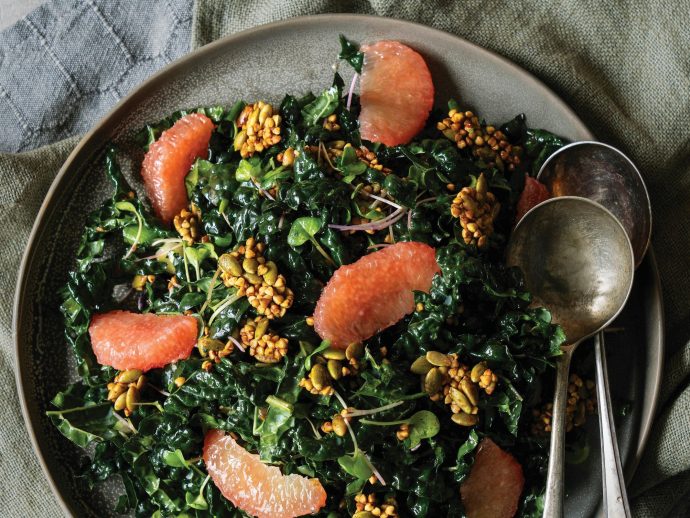
  • Detox Salad

    Detox Salad

    Detox Salad

    Total Time 35 minutes
    Servings: 4

    Ingredients
      

    • ¾ pound green cabbage
    • ½ pound broccoli florets
    • ½ bunch dino or lacinato kale
    • ¼ pound carrots
    • ½ cup roasted almonds
    • cup sunflower seeds roasted
    Maple-Tahini Dressing
    • cup tahini
    • 5 tablespoons water
    • 4 tablespoons apple cider vinegar
    • 3 tablespoons maple syrup (or to taste)
    • 2 tablespoons olive oil
    • ¾ teaspoon sea salt

    Method
     

    1. Thinly slice cabbage and broccoli. Remove kale from stems and roughly chop. Peel and grate carrots. Add vegetables to a mixing bowl.
    2. In a separate bowl, whisk together dressing ingredients until smooth and creamy. Adjust seasoning to taste.
    3. Pour ⅓ of the dressing over the salad and toss to combine, adding more dressing as needed.
    4. Roughly chop the roasted almonds. Top salad with almonds and sunflower seeds. Enjoy!
  • Cranberry Wild Rice Salad

    Cranberry Wild Rice Salad

    Cranberry Wild Rice Salad

    Total Time 1 hour 10 minutes
    Servings: 4

    Ingredients
      

    • 2 cups wild rice
    • 8-12 cups water
    • Pinch of salt
    • 1 pound apples cored and chopped
    • ¾ pound Brussels sprouts trimmed and thinly sliced
    • 1 bunch scallions green and white parts thinly sliced
    • ½ cup dried cranberries
    • ½ cup toasted pecans roughly chopped
    • ½ cup avocado oil
    • ½ cup apple cider vinegar
    • ¼ cup honey or agave syrup
    • ¼ cup Dijon mustard
    • ½ teaspoon marjoram (optional)
    • ½ teaspoon sea salt

    Method
     

    1. Cook wild rice with water and salt in a pot, simmering for about 50 minutes or until tender. Drain any excess water and cool.
    2. Toss cooled wild rice with apples, scallions, Brussels sprouts, pecans, and cranberries.
    3. In a small bowl, whisk together avocado oil, vinegar, honey, mustard, marjoram, and salt until emulsified. Toss with salad and serve.

    Recipe Provided by INFRA

  • Frangipane Toast

    Frangipane Toast

    Frangipane Toast

    Total Time 40 minutes
    Servings: 10 slices

    Ingredients
      

    • 10 slices brioche bread
    • ½ cup unsalted butter melted
    • 6 tablespoons unsalted butter softened
    • ½ cup cane sugar
    • 1 large egg
    • 1 tablespoon almond extract
    • Pinch of salt
    • ½ cup almond flour
    • 2 tablespoons all-purpose flour
    • cup sliced almonds
    • 2 tablespoons powdered sugar for dusting

    Method
     

    1. Brush brioche slices with melted butter on both sides and place on two parchment lined baking sheets. Preheat oven to 350°F.
    2. Cream softened butter and cane sugar together until pale. Stir in egg, almond extract, and salt. Stir until combined.
    3. Add almond flour and all-purpose flour and fold in just until combined.
    4. Spread 2 tablespoons of almond mixture on each brioche slice and sprinkle on sliced almonds.
    5. Bake for 20-24 minutes or until the edges are golden in color. Remove from oven and dust with powdered sugar.

    Recipe Provided by INFRA

  • Gingerbread Coffee Syrup

    Gingerbread Coffee Syrup

    Gingerbread Coffee Syrup

    Total Time 20 minutes
    Servings: 3 cups

    Ingredients
      

    • 2 cups water
    • 2 cups brown sugar
    • 2 cinnamon sticks
    • 8 allspice berries
    • 6 whole cloves
    • 1 1-inch piece fresh ginger sliced
    • 1 teaspoon molasses

    Method
     

    1. Place all ingredients in a medium saucepan over medium-low heat.
    2. Bring to a gentle simmer and cook for 15 minutes. Remove from heat and cool the syrup.
    3. Strain and store in an airtight container in the refrigerator for up to 2 weeks.

    Notes

    To Use: Add to brewed coffee or lattes as desired, start with a tablespoon of syrup per 10 ounces of coffee.

    Recipe Provided by INFRA

  • Cultivating sustainability

    Cultivating sustainability

    Cultivating sustainability

    A look into the future of farming

    The work Elijah Goerzen does as a farmer conjures times past. His Deep Roots Farm, set in Maple Ridge, BC, is small by modern Canadian farming standards. The eight-acre parcel near Vancouver is worked by hand rather than machine, resulting in healthy, nutrient-rich soil that’s fertile ground for vegetables to grow and for beneficial organisms, such as earthworms, to thrive.

    Goerzen doesn’t spray his heritage lettuce, microgreens, and vegetable crops with toxic pesticides or infuse them with chemical fertilizers either. Instead, he chooses to nurture biodiversity by planting flowers between his kale to attract hungry ladybugs that keep any aphid infestations in check or to serve as beacons to pepper-propagating pollinators.

    The future of farming?

    Really, though, the regenerative agriculture methods he uses to tease crops from his soil every growing season are considered by some to be the future of farming.

    It works out well for the planet, too. Unlike conventional agriculture, regenerative farming is rooted in harnessing the power of natural processes to produce food rather than dominating them with human-made inputs and interventions.

    The sky’s the limit

    Vision Greens, a vertical farm in Welland, Ontario, is proving him right. Set in a southern Ontario rust belt city abutting Niagara’s shrinking tender fruit belt, Vision Greens is putting stock in growing up rather than out to help meet a demand for food that the UN projects will increase by 60 percent by 2050.

    It’s disrupting the imported lettuce market with its controlled environment agriculture that marries continuous food production with sustainability.

    Vision Greens’ headquarters in an industrial park is filled with towers of hydroponic trays loaded with organic seeds grown by a computer-controlled system that regulates LED lighting, organic nutrients, reverse osmosis water filtration, air flow, and carbon dioxide levels to meet crop needs. The result: perfect, nutrient-dense lettuce harvested every 26 days, winter, spring, summer, or fall.

    Those crops are perfect because they aren’t exposed to insects, disease, or weather fluctuations, eliminating the need to spray.

    Harvests are delivered to a warehouse, often on the day they’re picked, 76 km away. Meanwhile, most conventional and organic romaine sold here must travel more than 4,300 km from California’s Salinas Valley, where growing and shipping conditions vary and make produce vulnerable to dangerous bacterial contamination.

    The very nature of their production and transport methods means Vision Greens lettuce will never have to be pulled off store shelves in the name of safety. And with plans to build one-acre vertical farms elsewhere in Canada that have 60 times the growing density and 135 times greater crop yield than field lettuce, the company is poised to play as significant a role in building secure local food systems as Deep Roots Farm.

    By Tiffany Mayer

    Article Courtesy of Alive Magazine