Category: How-To

  • What makes people healthy?

    What makes people healthy?

    What makes people healthy?

    Exploring the social determinants of health


    Why are some people healthier than others? Yes, your genes play a big role. But there are other determinants of health that have nothing to do with your genetic makeup. Where you live, how you’re educated, and other societal influences are all important factors in our health. Find out more.


    Two hypothetical kids

    There are significant implications for advantage and disadvantage related to social determinants of health. Look at socioeconomic position, for example: a child born into a higher tax bracket is much more likely to be in a higher tax bracket when they’re older.

    Let’s take a look at the life course trajectories of two hypothetical kids. Joe is born into an affluent neighborhood, while John lives in subsidized housing with his six siblings in a single parent home.

    Joe’s parents are able to afford organic produce, put Joe into private school, and drive him to and from his various sporting activities throughout his childhood. As a result, Joe gets an excellent education that allows him to attend university, secure a job in a top tax bracket, and enjoy an active social life.

    John’s father works double shifts to make ends meet, but the only apartment he can afford has a black mold problem that has given John respiratory issues for years. John’s school is oversubscribed, and he’s falling behind because of sick days. To support the family, John takes a construction job and eventually drops out of high school. Years of manual labor and poor self-care have taken their toll on John, and he lives with chronic pain.

    You can imagine that two very different states of health and well-being are being experienced by Joe and John in later life. These differences may not necessarily be due to differences in the individuals, but in the broader social and economic circumstances in which they find themselves.

    What next?

    To address systemic issues such as the negative impact of social determinants of health, we must look to addressing modifiable aspects of lifestyle at the individual level and systemic inequities at the population level.

    Your DNA is not your destiny

    Although there are many social determinants of health that you can’t control, focus on the ones that you can control, such as diet, exercise, and social connections.

    • Pack yourself a healthy lunch.
    • Go for an evening walk with your partner.
    • Plan a family gathering.

    When you need nutritional help, chat with your health care practitioner. They may recommend certain supplements, such as the following:

    Nutritional helperBenefits
    vitamin Cimmune health, wound healing, bone health, antioxidant protection
    vitamin Dbone health maintenance, decreased risk of cancer mortality, mood stabilization
    vitamin B6red blood cell formation, brain processes and development, immune function, and steroid hormone activity
    vitamin B12brain support, red blood cell genesis support, energy booster
    magnesiummuscle repair, neuromuscular facilitation, blood sugar control
    zincsleep support, digestive support, reproductive organ support

    Article courtesy of Alive Magazine

  • Exercise Outside

    Exercise Outside

    Exercise Outside

    Sea-to-sky adventures for men’s physical and mental health


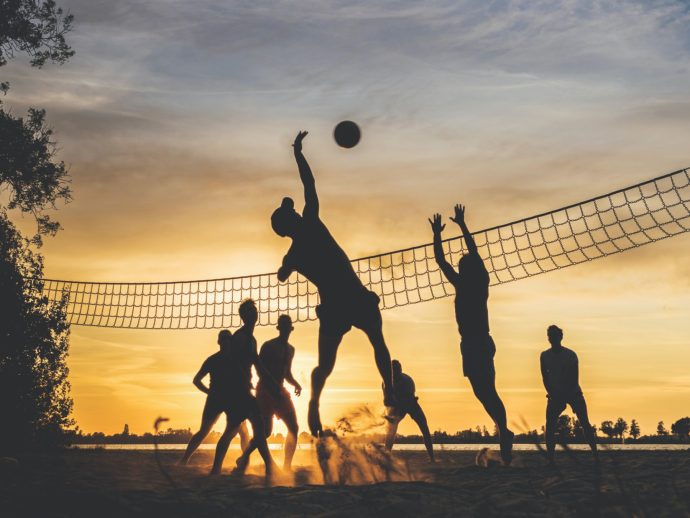
    Do you enjoy exercising outdoors? Compared to indoor exercise, numerous studies have shown that guys who turn the great outdoors into their workout studio are more motivated to exercise, push themselves harder, and feel more grounded and restored. Get started with al fresco adventures.


    Embark on a unique exercise adventure

    “Nothing improves my mood and perspective more quickly than a scramble up a peak on the Great Divide Trail,” says personal trainer Chad Alexander. “When I’m stuck in my head or worrying about something, I remember how alive I felt on that mountaintop cliff.”

    Here are some thrilling activity ideas to inspire your next adventure.

    • Travel from sea to sea to sea on foot by hiking or bikepacking (which is mountain biking fused with backpacking and camping).
    • Go rock climbing.

    Consider scuba diving (or shipwreck diving!).

    • Soar to new heights with kitesurfing (where a strong gust of wind launches you sky-high off a cresting ocean wave or propels you quickly across a smooth lake).
    • Try out hang-gliding or paragliding.

    Forge some friendly competition

    For something a little closer to home, unique team sports can get you moving in the fresh air.

    Ultimate frisbee and disc golf have recently exploded in popularity. The number of local disc golf courses, for example, has jumped by 300 percent in the last few years. Other off-the-beaten-path outdoor sports include archery, handball, and even Harry Potter-inspired quidditch.

    Team sports are some of the best ways for men to build long-term, positive mental health outcomes. “Outdoor activities have changed my life in terms of mental health,” says Robert Puharich, a high school teacher. “Having teammates gives me a sense of community.”

    Rise to the challenge: 3 benefits to pushing your limits

    Testosterone

    Friendly competition in team sports has been shown to raise your testosterone levels. This hormone is key for strength, endurance, and your sex life.

    Motivation

    Once you’ve beaten your competition, or even beaten your own self-doubt, you’ll feel more motivated and driven to tackle life’s challenges.

    Self-confidence

    Pushing yourself on a grueling adventure forces you to tap into your own confidence, self-trust, and skills. Over time, psychologists say, this builds self-efficacy and resilience.

    The best time to exercise outdoors

    With longer daylight hours, your window of opportunity is wide open. The best time to head out and get your sweat on depends on your goals.

    Mornings

    If you’re trying to lose weight, morning exercise on an empty stomach may reduce your food cravings later, and it also leads to burning more fat.

    Midday

    Exercise reduces stress and boosts your energy, making it the perfect escape in the middle of your workday.

    Afternoons

    Your muscles contract more effectively when you’re warmed up. For peak physical strength and endurance, your body’s natural temperature peaks in the afternoon.

    Article courtesy of Alive Magazine by Joshua Duvauchelle
  • Road Trip Cooking

    Road Trip Cooking

    Road Trip Cooking

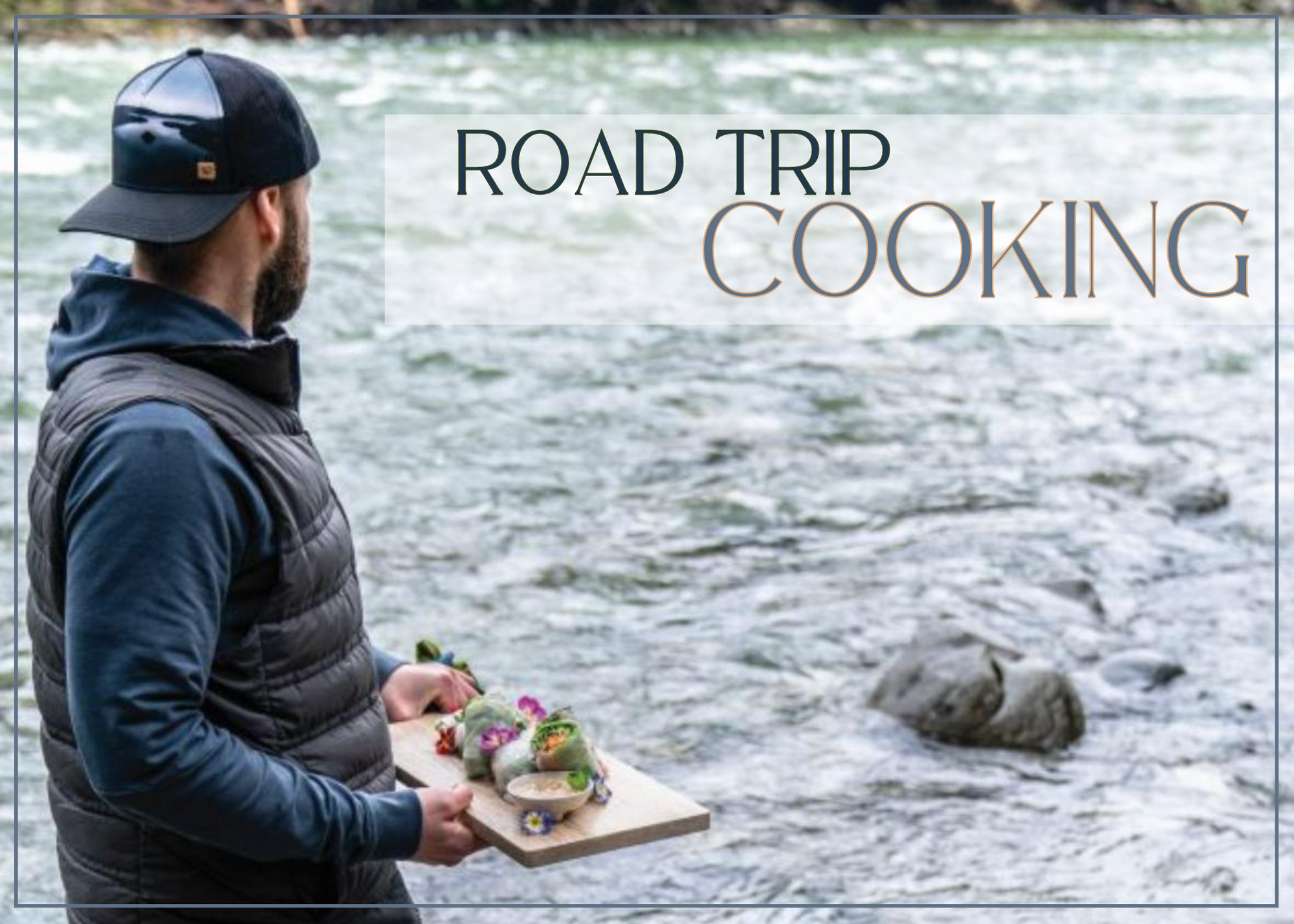
    Go exploring with these make-ahead recipes.


    Piling into the car and hitting the open road presents both challenges and delights. When planning your on-the-road menu, choose dishes that pack well or that get better as leftovers. Dig out your cooler and read on—it’s time to hit the road!


    Kale and Napa Cabbage Salad with Sumac Pickled Onions

    Kale and Napa cabbage stand up for hours to the sweet and puckery dressing, and hearty farro will keep you going while on the road.
    Servings: 8

    Ingredients
      

    • 1 Cup red onion finely sliced
    • 3 Tablespoons apple cider vinegar
    • 1/4 Teaspoon crushed red pepper flakes
    • 1 Teaspoon maple syrup
    • 1 Teaspoon sumac
    • 1/4 Teaspoon salt
    • 1/4 Teaspoon black pepper
    • 2 Tablespoons olive oil divided
    • 5 Cups kale finely sliced
    • 1 Cup Napa cabbage finely sliced
    • 2/3 Cup fresh mint finely sliced
    • 3 Medjool dates pits removed, finely chopped
    • 2 Cups cooked farro drained and cooled

    Method
     

    1. In small bowl, combine onion, vinegar, red pepper flakes, maple syrup, sumac, salt, and pepper, and set aside.
    2. In large bowl, add 1 Tbsp olive oil and kale, and massage kale for a few minutes with your hands. Let stand for 20 minutes.
    3. To assemble salad, toss kale, pickled onion dressing, and remaining olive oil with cabbage, mint, dates, and farro. Keep cool or refrigerate for up to 4 hours before enjoying.

    Freeze-Ahead Breakfast Wraps

    Make these wraps anytime and stick them in the freezer for your next excursion.
    Servings: 6

    Ingredients
      

    Wraps
    • 2 Tablespoons olive oil
    • 2 Cups sweet potato peeled, diced
    • 2 Teaspoons sweet smoked paprika
    • 1 Cup shallot finely diced
    • 1 Cup red bell pepper diced
    • 2 Oz goat cheese
    • 1 Cup baby spinach leaves chopped
    • 8 eggs beaten
    • 6 10 inch tortillas
    Smoky red pepper “ketchup”
    • 1 Teaspoon olive oil
    • 1 red bell pepper
    • 6 baby plum tomatoes
    • 2 Medjool dates pitted
    • 1/4 Teaspoon salt
    • 1/2 Teaspoon sweet smoked Spanish paprika
    • 1/8 Teaspoon hot Spanish paprika

    Method
     

    1. For wraps, in large skillet on medium-high, heat 1 Tbsp olive oil, add sweet potatoes, and cook for about 5 to 7 minutes, stirring occasionally. Once sweet potatoes are tender, pour into bowl and add sweet smoked paprika; stir through.
    2. In the same skillet, add 1 Tbsp olive oil, shallots, and red bell pepper and cook on medium-low heat for 2 to 3 minutes, until soft and shallots are translucent. Scrape into bowl with sweet potatoes and add goat cheese and spinach leaves; stir to combine.
    3. Wipe out skillet, add remaining 1 tsp olive oil, and heat on medium. Pour in beaten eggs and stir while cooking until you have a loose custard, approximately 3 minutes. Add vegetables from bowl into skillet and stir through to combine, being careful not to overcook eggs. Remove from heat.
    4. Lay out tortillas, divide egg-vegetable mixture evenly among them, and wrap or roll. Allow to cool completely and pack for freezing.
    5. To make ketchup, rub red bell pepper and tomatoes with olive oil, add to baking dish, then place under oven broiler. Turn pepper, broiling for 5 minutes on each side, until the whole pepper is blackened. Toss tomatoes occasionally and remove them in advance of the pepper if they’re getting too dark. They should be slightly charred. When pepper is black on all sides, remove from oven and place in paper bag to cool. Tomatoes can cool in baking dish.
    6. Meanwhile, in food processor, pulse dates to chop. Once bell pepper is cool, remove and discard skin. In bowl of food processor, place pepper, tomatoes, and remaining ingredients and pulse until you have a sauce with a loose texture. Seal in container and refrigerate or freeze.
    7. When it’s time to cook, thaw wraps and sauce in fridge or cooler for 8 hours or overnight. To cook wraps, warm on medium-hot grill for 5 to 7 minutes each side, until center of wrap is warm.

    Vegetable and Cashew Salad Rolls with Peanut Sauce

    Veggies and dip are a healthy road trip staple. Take them a step further in this recipe, inspired by Vietnamese-style salad rolls.
    Servings: 4

    Ingredients
      

    Peanut sauce
    • 3 Tablespoons peanut butter
    • 1.5 Tablespoons rice wine vinegar
    • 1 Teaspoon sesame oil
    • 1/2 Teaspoon tamari
    • 4 Tablespoons water or more as required
    • 1/2 Teaspoon ginger grated
    • 2 garlic cloves peeled and crushed
    • 1/4 Teaspoon crushed red pepper flakes
    Salad rolls
    • 8 rice paper wrappers
    • 1 Bunch fresh mint leaves
    • 4 radishes thinly sliced
    • 8 butter lettuce leaves
    • 5 broccoli florets thinly sliced
    • 24 cashews pulsed in food processor to pea-sized pieces
    • 2 medium carrots cut into matchsticks
    • 1 Cup baby spinach leaves stems removed

    Method
     

    1. In small bowl, combine peanut butter, rice wine vinegar, sesame oil, and tamari. Add water, a little at a time, and mix slowly with a fork or spoon to gradually loosen the stiff peanut butter mixture. Once sauce is smooth, if you want a looser consistency, add more water, a teaspoon at a time. Once you’re happy with the consistency, add gingerroot, garlic, and red pepper flakes; mix through, and then pack into a sealable container.
    2. To assemble rolls, first set out a clean cutting board for your workspace. Fill a wide, shallow bowl with hot (not boiling) water and, working quickly, soften one wrapper in water and lay it on your cutting board. Place 3 mint leaves and 3 radish slices on wrapper. Add lettuce, fill with cashews, a few slices of broccoli, and a few carrot matchsticks, and finally spinach. Roll tightly and repeat with remaining wrappers until you have 8 rolls.
    3. Pack in a sealable container, keep cold, and eat within 24 hours with spicy peanut sauce.

    Article courtesy of Alive Magazine

  • Healthy Mango Smoothie + How-To Cut A Mango!

    Healthy Mango Smoothie + How-To Cut A Mango!

    Healthy Mango Smoothie + How-To Cut A Mango!

    Thanks to Christine Waltermyer & The Natural Kitchen Cooking School!

    Christine Waltermyer is a local and renowned Wellness Chef, private chef to celebrities, published cookbook author and founder of the Natural Kitchen Cooking School, which offers an online Plant-Based Cooking Program. She also loves shopping at Basil Bandwagon! Visit naturalkitchenschool.com to subscribe to her email newsletter for new recipes, tips, and FREE access to the Power of Veggies mini-course!


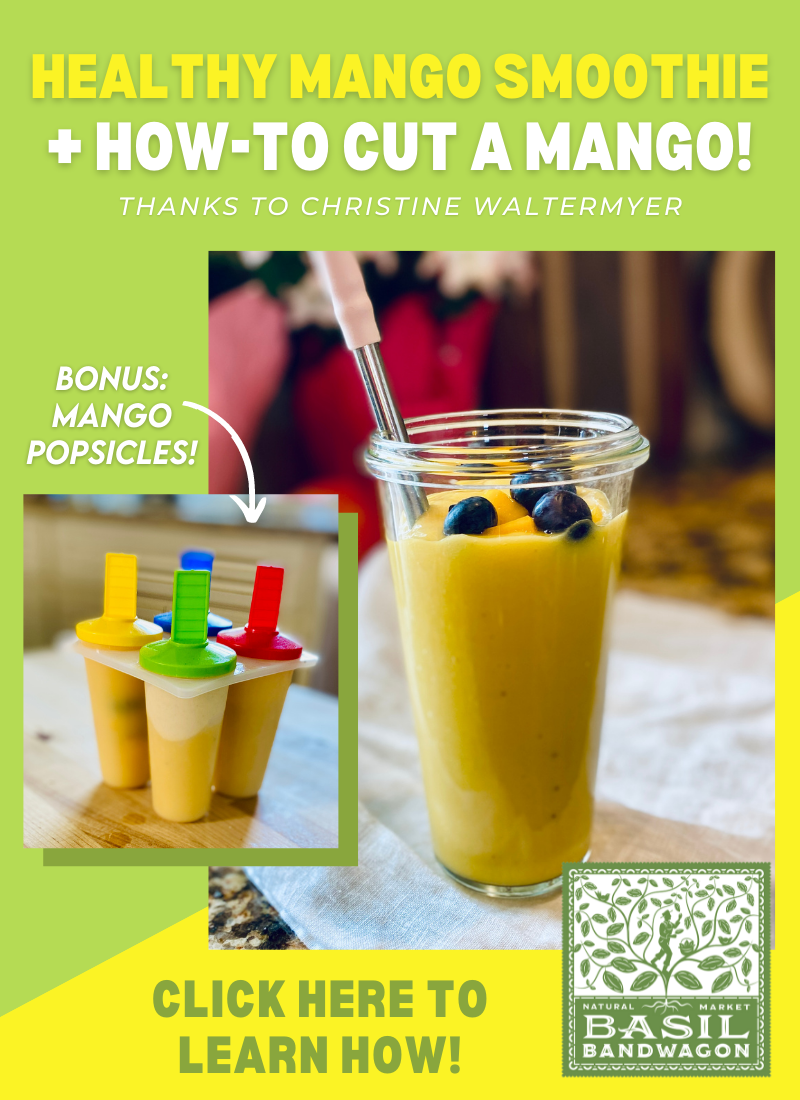
    If you LOVE mangoes then this recipe is just what you’re looking for. Thanks to Christine Waltermyer and The Natural Kitchen Cooking School, we’re learning how to cut a mango and use them to make a refreshing smoothie that you and your kids will love! Bonus – if you have leftover smoothie, you can turn them into frozen popsicles. Whether you like mangoes fresh or frozen, you’ll always know your snack is nutritious, delicious and will bring you an instant energy boost!

    Healthy Mango Smoothie

    Course Breakfast, Dessert, Snack
    Keyword breakfast, dessert, Kids, smoothie, snack
    Servings 2

    Ingredients

    • ½ cup frozen banana slices
    • 1 cup fresh diced mango
    • 1 cup frozen mango chunks
    • ½ cup your favorite plain yogurt
    • Pinch of salt
    • 1 teaspoon vanilla extract

    Instructions

    • Place all ingredients in a high-powered blender and puree until smooth. Enjoy served in a tall glass with a straw!

    Notes

    Leftover smoothie makes great popsicles! Just pour into popsicle molds and freeze.

    Thank you to Christine Waltermyer and the Natural Kitchen Cooking School for working with us to help promote healthy, nutritious meals and products that are affordable, full of nutrients, and simple to make at home!

  • How-To: Sauté Collard Greens

    How-To: Sauté Collard Greens

    How-To: Sauté Collard Greens

    Thanks to Christine Waltermyer & The Natural Kitchen Cooking School!

    Christine Waltermyer is a local and renowned Wellness Chef, private chef to celebrities, published cookbook author and founder of the Natural Kitchen Cooking School, which offers an online Plant-Based Cooking Program. She also loves shopping at Basil Bandwagon! Visit naturalkitchenschool.com to subscribe to her email newsletter for new recipes, tips, and FREE access to the Power of Veggies mini-course!


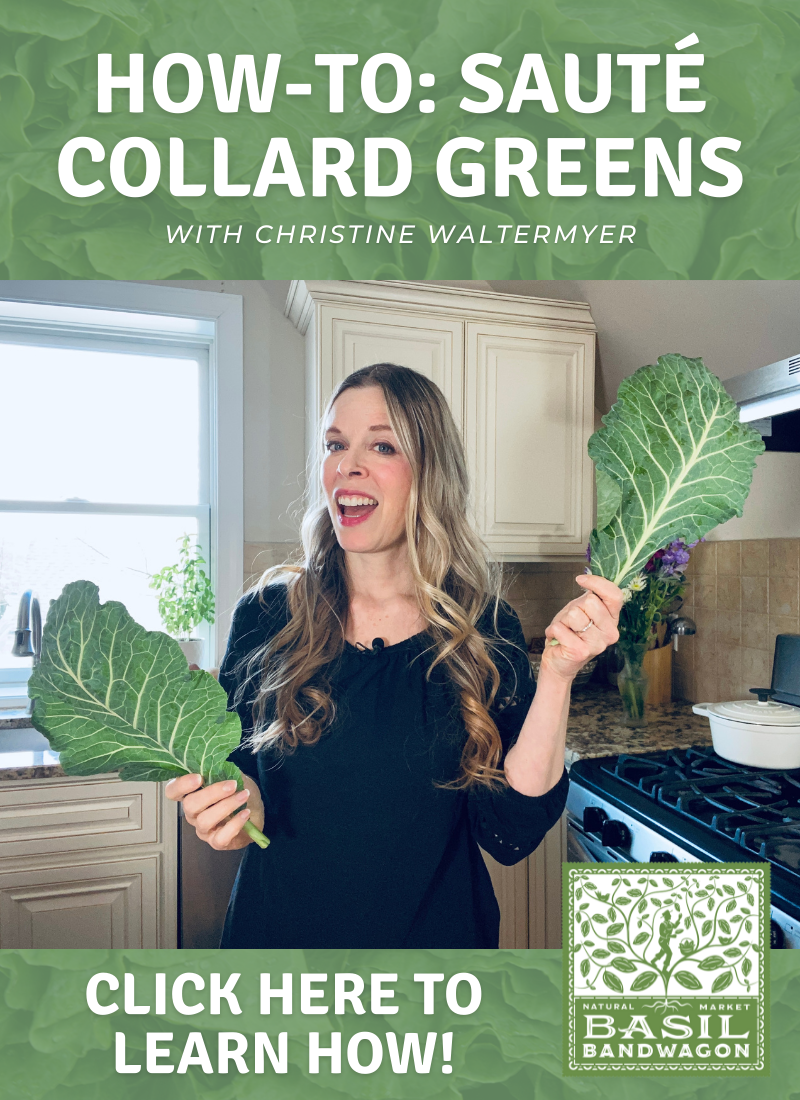
    Did you know Collard greens are the oldest leafy green within the cabbage family dating back 2000 years, originally grown by the ancient Greeks and Romans! This low calorie vegetable is packed with many nutrients like Vitamins K, C, A, calcium and folate. Thanks to Christine Waltermyer and the Natural Kitchen Cooking School, you can learn how to properly sauté these greens so that your whole family will love them, too!

    How-To: Sauté Collard Greens

    Course Side Dish
    Keyword collard greens, collards, how-to, sauté, side
    Servings 8

    Ingredients

    • ½ to 1 cup water
    • 1 bunch collard greens stems trimmed and leaves cut into small pieces
    • 1 cup sliced scallions
    • Sea salt and pepper to taste
    • Splash lemon juice

    Instructions

    • Place the water in a large skillet and heat on medium high heat. Add the collard greens, scallions, sea salt, pepper and lemon juice.
    • Cover and cook on high for 3 to 5 minutes. Stir occasionally. Serve as is or with your favorite dressing.
    • Enjoy!

    Thank you to Christine Waltermyer and the Natural Kitchen Cooking School for working with us to help promote healthy, nutritious meals and products that are affordable, full of nutrients, and simple to make at home!

  • How-To: Cut Butternut Squash

    How-To: Cut Butternut Squash

    How-To: Cut Butternut Squash

    Thanks to Christine Waltermyer

    Christine Waltermyer is a local and renowned Wellness Chef, private chef to celebrities, published cookbook author and founder of the Natural Kitchen Cooking School, which offers an online Plant-Based Cooking Program. She also loves shopping at Basil Bandwagon! Visit naturalkitchenschool.com to subscribe to her email newsletter for new recipes, tips, and FREE access to the Power of Veggies mini-course!


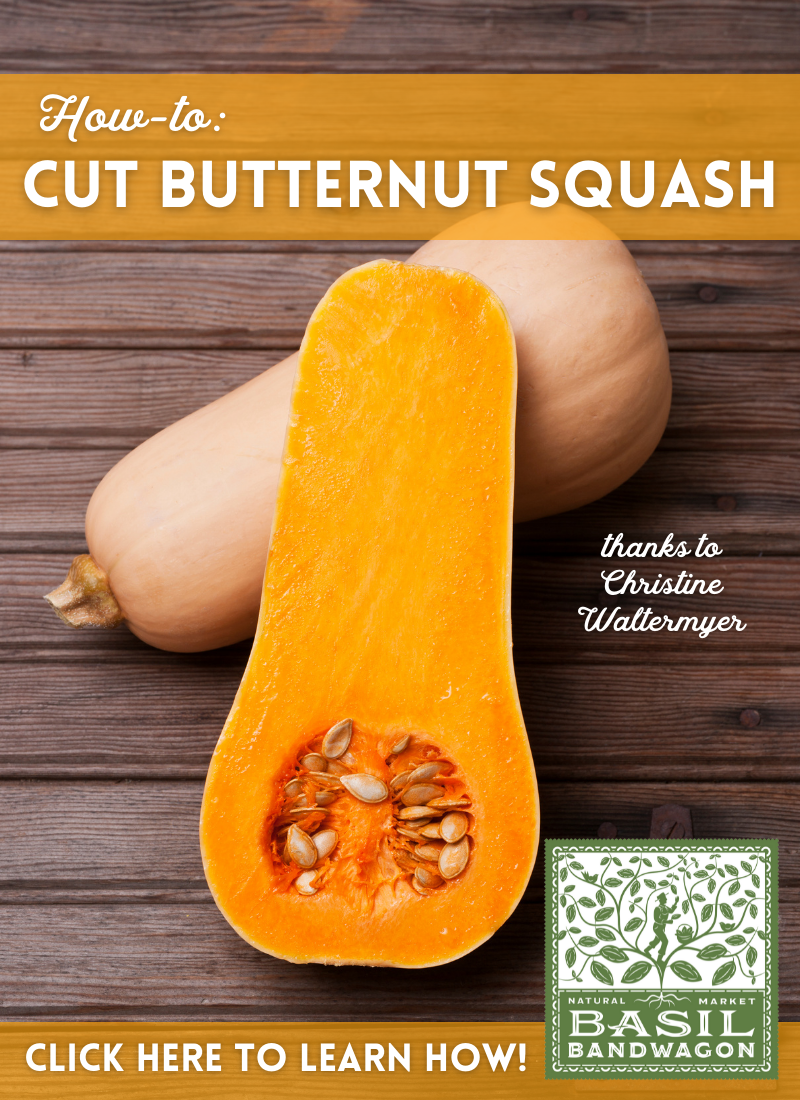
    Did you know that squash and melons are related? Although related, cutting them is slightly different! Thankfully, Christine Waltermyer and The Natural Kitchen Cooking School has perfected how to cut a butternut squash – and created a how-to video for us. The next time you shop at Basil Bandwagon Natural Market, pick up a fresh, organic butternut squash, practice your cutting skills, and add it into your favorite recipe!

    How-To: Cut Butternut Squash

    Keyword butternut squash, how-to

    Ingredients

    • 1 butternut squash

    Instructions

    • Place the butternut squash on a cutting board. Using a sharp knife, carefully remove any bad spots. Carefully slice off both ends of the squash.
    • If you want to peel the squash, use a peeler to remove the skin. Note that the peeled squash is slippery. So if you find it difficult to hold onto, you can use a paper towel to dry it off a bit.
    • Cut the length of the squash in half, separating the part that contains the seeds from the “neck” of the squash.
    • Use a spoon to remove any seeds from the neck of the squash. Place on the cutting board the flat cut side of the half containing the seeds. Cut this in half. Use a large spoon to remove the seeds.
    • Decide what size pieces you want to cut: fine dice, small dice, medium dice, large dices, etc. If cutting into fine diced pieces, slice the squash into very thin pieces. Then cut those pieces into long thin sticks. Cut the other direction to make small dices. If making big chunks, cut into roughly ½-inch size long pieces, then cut them into long strips and cut the other direction to make ½-inch squares. Use in your favorite recipes.

    Thank you to Christine Waltermyer and the Natural Kitchen Cooking School for working with us to help promote healthy, nutritious meals and products that are affordable, full of nutrients, and simple to make at home!